Your HR Stack Has Data. The Platform Turns It Into Decisions.
Connects 40+ HR systems into unified talent profiles, then applies predictive models across hiring, retention, succession, mobility, learning, and workforce optimization. Intelligence starts in weeks, not quarters.
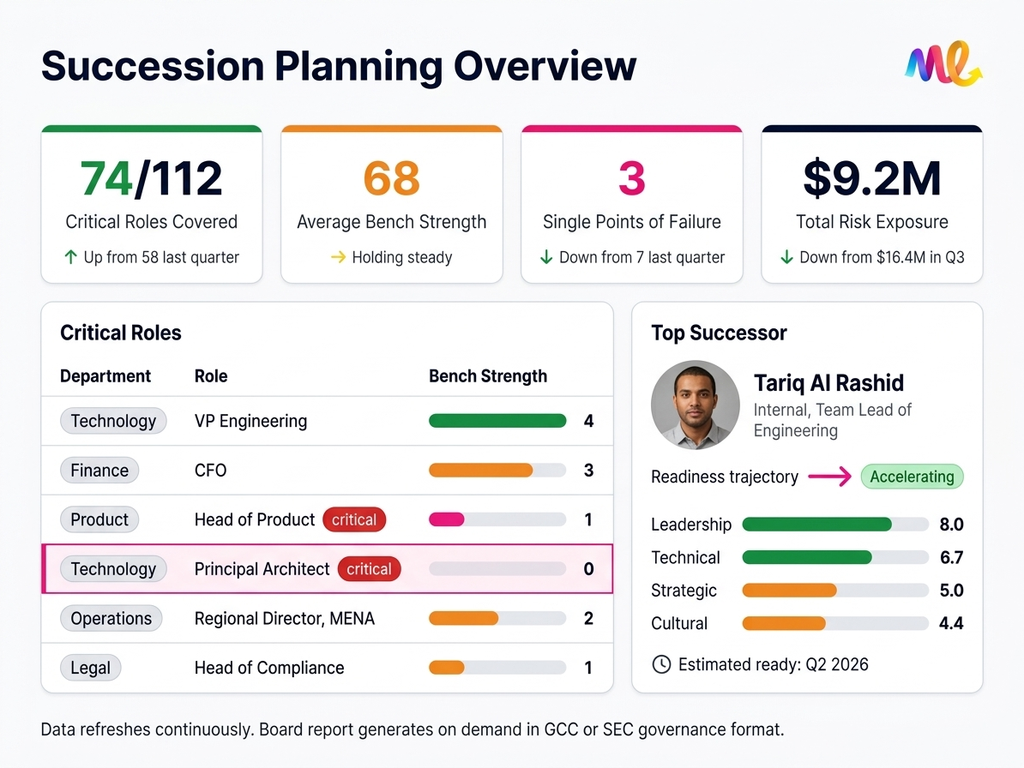
Six Intelligence Domains
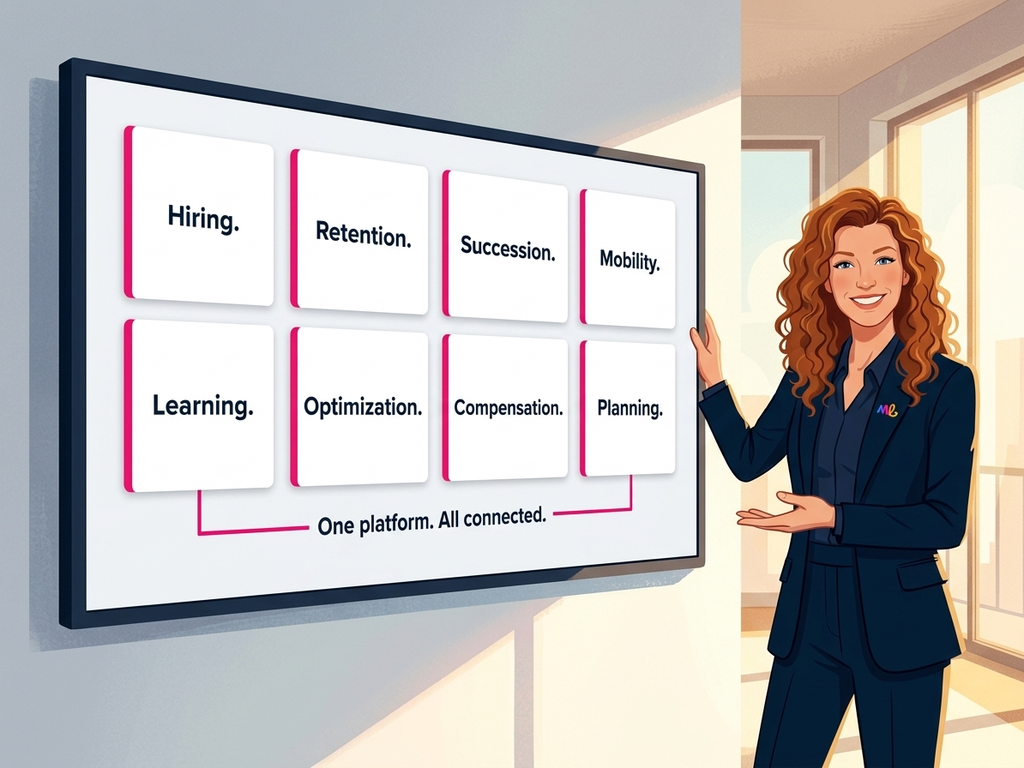
One Platform. Every Workforce Decision.
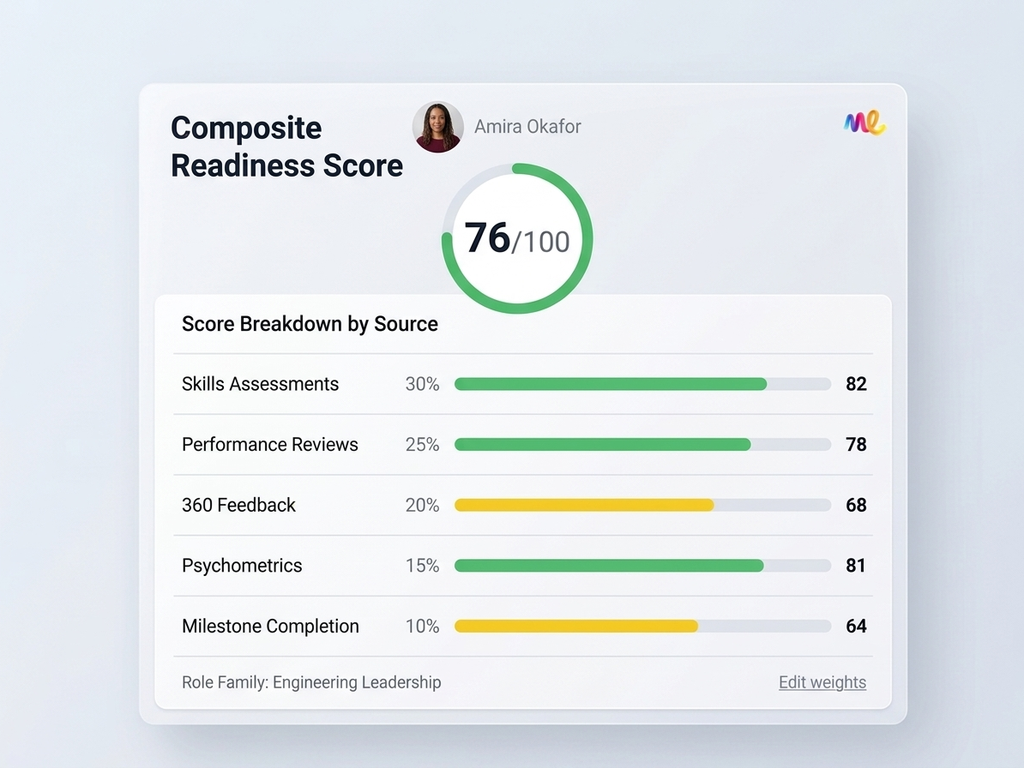
Each domain runs on the same unified profiles. Intelligence flows between them: retention data sharpens succession, quality-of-hire recalibrates scoring, skill gaps trigger learning. Standalone tools cannot replicate what a connected system compounds.
- Hiring Intelligence
- Scores candidates against top-performer patterns derived from your data. Surfaces internal talent first. Connects every hiring outcome to quality metrics that retrain the next model.
- Learn more
- Retention Intelligence
- Scores flight risk weekly using compensation, engagement, and behavioral signals. Names the drivers. Recommends interventions calibrated to each individual. Tracks whether they work.
- Learn more
- Succession Planning
- Scores readiness across six dimensions. Detects single points of failure. Generates board-ready reports with trended metrics and dollar-denominated risk in hours, not weeks.
- Learn more
- Internal Mobility
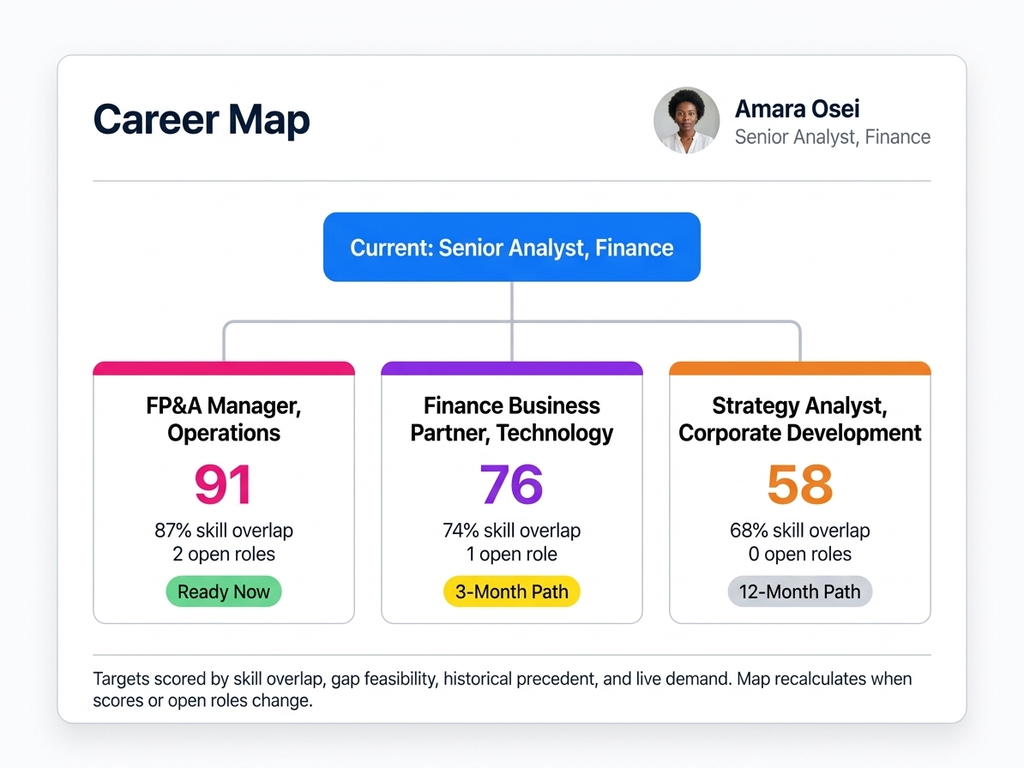
- Matches every open role to qualified internal candidates first. Maps career paths from actual movement data. Turns your workforce into one searchable talent pool across entities.
- Learn more
- Learning & Development
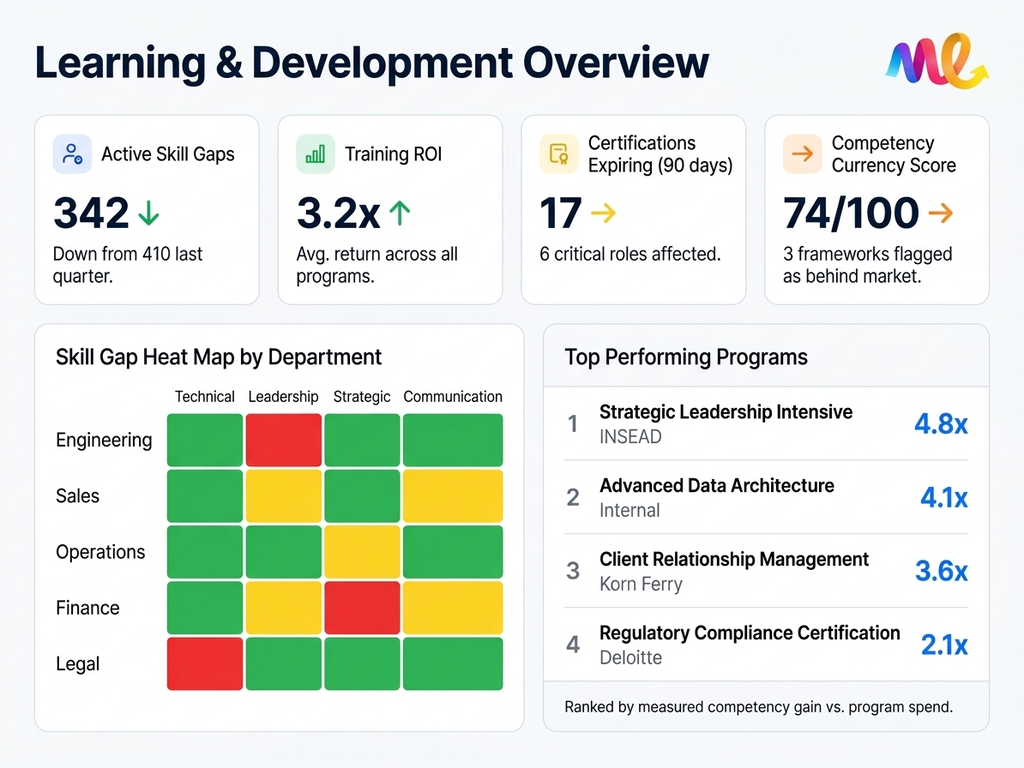
- Maps skill gaps against role requirements. Measures training ROI with control groups. Generates personalized development pathways calibrated to each employee's gaps and goals.
- Learn more
- Workforce Optimization
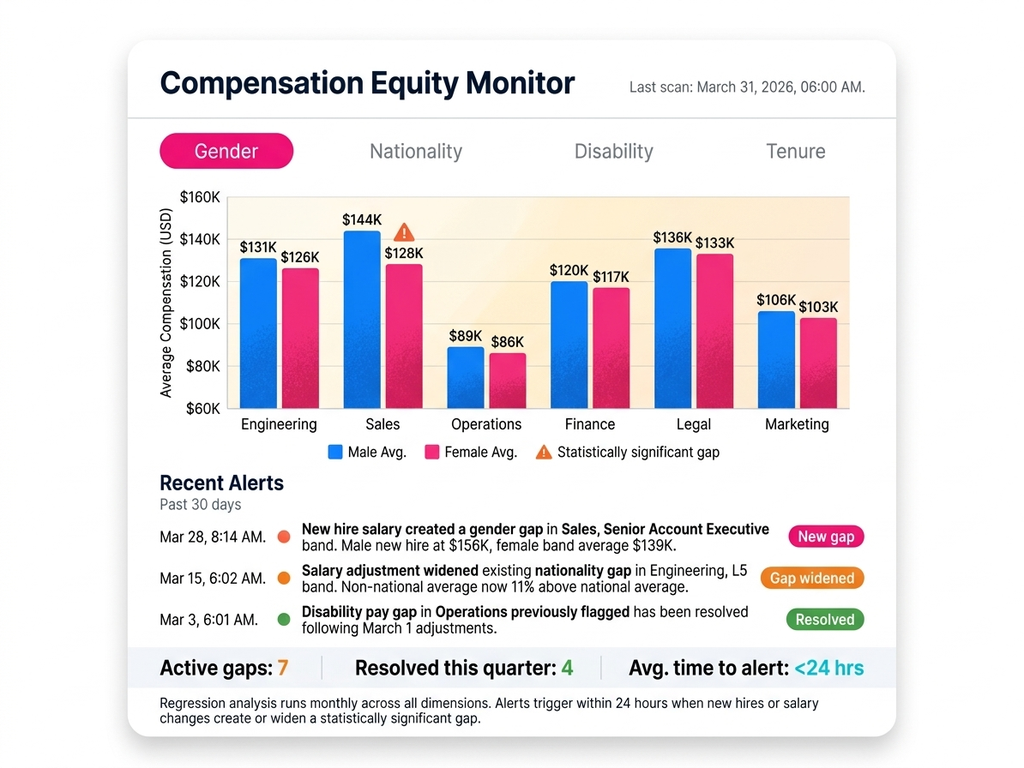
- Models restructuring with hidden-cost analysis. Surfaces pay inequities before regulators do. Detects role redundancy across entities. Forecasts workforce composition years ahead.
- Learn more
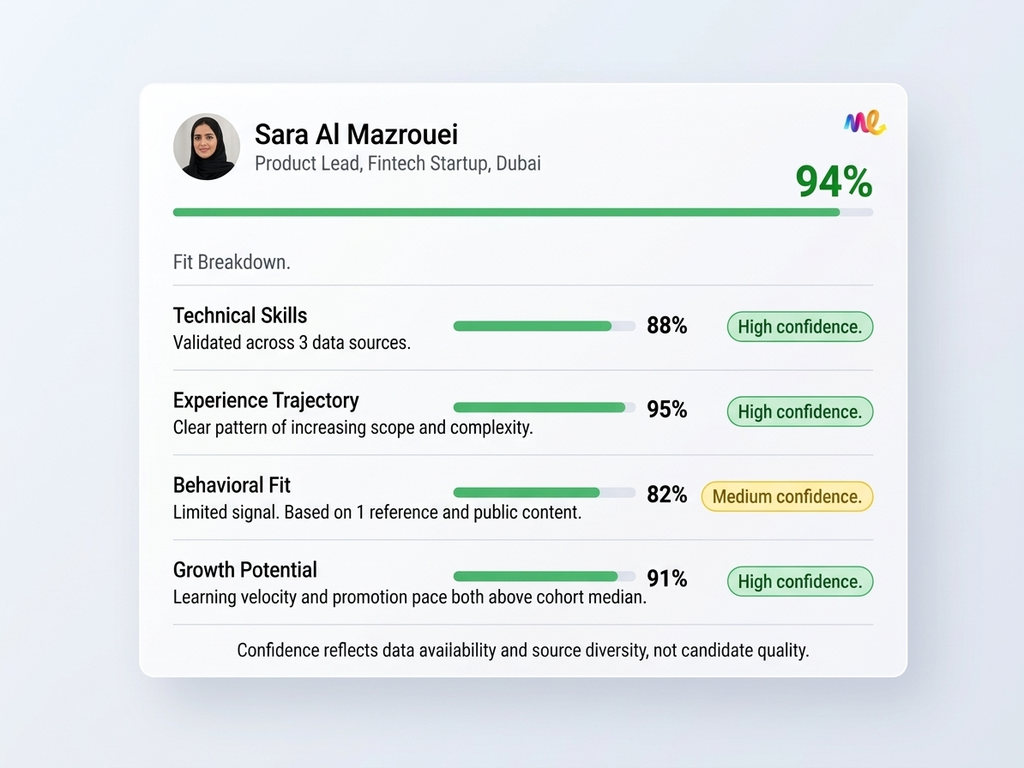
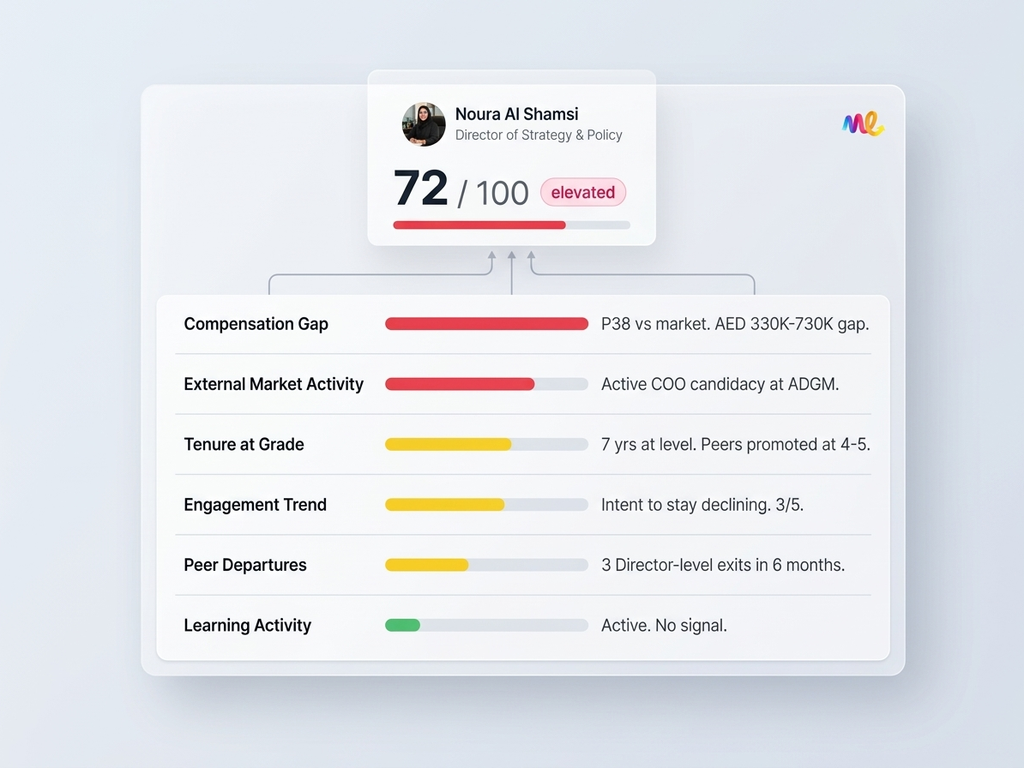

10,000 people. One question at a time.
Enterprise workforce intelligence without the 6-month consulting engagement. Ask Meg. Get the answer now.
Common prompts (click to see!)
Meg AIC-Suite Succession Readiness
Roles with Ready-Now Successor
3 of 5
60%
Board Benchmark
80%+
Industry standard
Avg Readiness Score
64/100
Below peer median of 72
Connects to the systems your teams already run



Enterprise Impact
The Numbers Behind the Intelligence Layer
Enterprise HR operates across 10-20 disconnected systems. The ATS knows who applied. The HRIS knows who was hired. The PMS knows who performed. Nobody has the connected picture. The platform resolves employee identities across these systems, normalizes schemas, and builds unified profiles that feed every workforce decision. Foundation integrations go live in two to three weeks. Full ecosystem connection completes within 90 days.
The cost of talent decisions made without intelligence is measurable. A 5,000-person organization typically spends $5-15M annually on regrettable turnover alone. Each prevented departure saves $50,000-200,000 in direct replacement costs. First-year attrition runs 30-40% when hiring is based on resume screening and unstructured interviews. Predictive scoring cuts that number in half.
Predictive models start with industry benchmarks for baseline accuracy from day one. As your organization's outcome data accumulates, models retrain quarterly. Flight risk prediction reaches 75-85% accuracy within twelve months. Candidate fit scoring reaches 0.55+ correlation with performance outcomes. Every domain gets sharper because every domain feeds the others.
The platform pays for itself if any single outcome category delivers even modest improvement. At $4 per employee per month, preventing 12 mid-level departures covers the annual cost. Reducing time-to-fill by 5 days across 200 hires generates $1M in avoided vacancy cost. Redirecting 5% of L&D spend from ineffective programs recovers $500K. Most enterprise organizations see multiple categories compound simultaneously.
- HR Systems Connected
- 40+
- Document Types Parsed
- 50+
- Year-One Model Accuracy
- 75-85%
- Typical Enterprise ROI
- 73-258x
Unified Profiles
Build Talent Profiles from Evidence, Not Self-Reported Claims
Resumes are self-marketed snapshots. The platform builds profiles from 50+ document types across every connected system: performance reviews, assessments, credentials, compensation records, and peer feedback. Every data point weighted by who said it and when.
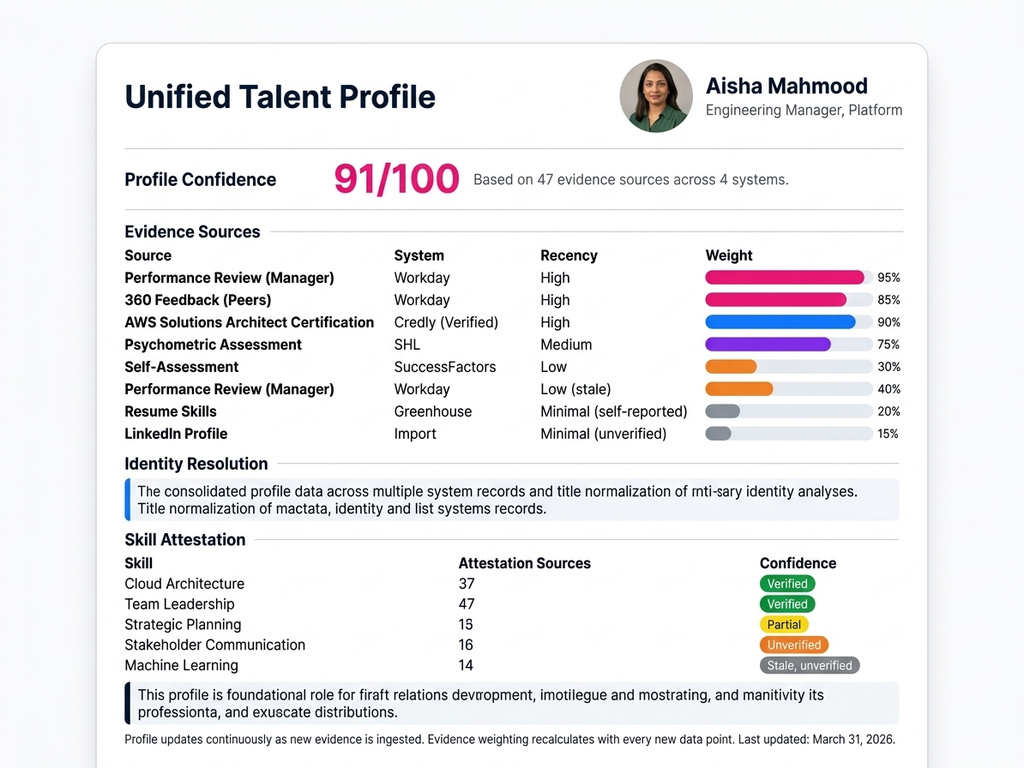
A government-verified credential outweighs a self-reported skill. A performance review from six months ago outweighs one from three years back. Manager assessments carry different weight than self-assessments. The platform applies evidence weighting to every data point so the profile reflects demonstrated capability, not claimed capability. For enterprise organizations running 10-20 HR systems, this is the difference between a people analytics project that takes six months and an intelligence layer that works from week three.
Identity resolution maps the same person across systems where they exist as three different records. Job titles normalize so 'Senior Software Engineer' in one entity maps to 'Staff Developer' in another. Temporal intelligence tracks every data point with a timestamp so career trajectories, skill progression, and compensation changes form a time series, not a point-in-time snapshot.
Predictive Intelligence
Six Workforce Domains. One Model Architecture. Compounding Accuracy.
Applies domain-specific models to unified profiles. Flight risk, succession readiness, candidate fit, skill gaps, cost modeling, and mobility matching all run on the same evidence base and reinforce each other.
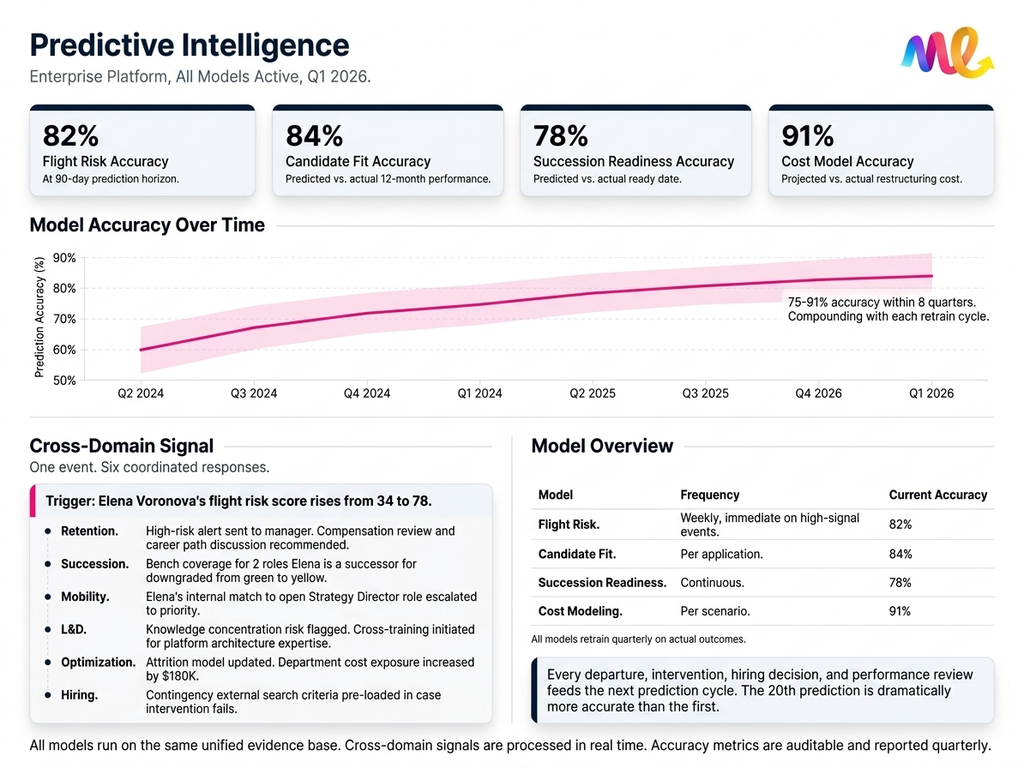
Most enterprise HR platforms deliver descriptive analytics: what happened last quarter. The platform delivers predictive intelligence: what will happen next quarter and what to do about it. Flight risk scoring identifies which employees will leave in the next 90 days. Succession readiness scoring predicts when each candidate will cross the 'ready now' threshold. Candidate fit scoring predicts which hires will perform and stay. Each prediction comes with factor attribution so decision-makers see why, not just what.
The compounding effect is where enterprise organizations see returns that standalone tools cannot match. When a high-performing engineer's flight risk score rises, the system simultaneously updates succession coverage for the roles she could fill, adjusts the workforce optimization model's attrition assumptions, and flags her departure as a knowledge concentration risk for L&D. One signal. Six domains. One coordinated response.
Enterprise Integration
Connects to Your Stack in Weeks. Not Quarters.
Pre-built connectors cover 40+ platforms across 10 HR system categories. Bidirectional data flow means intelligence surfaces inside the tools your teams already use, not in a separate portal nobody checks after the first month.
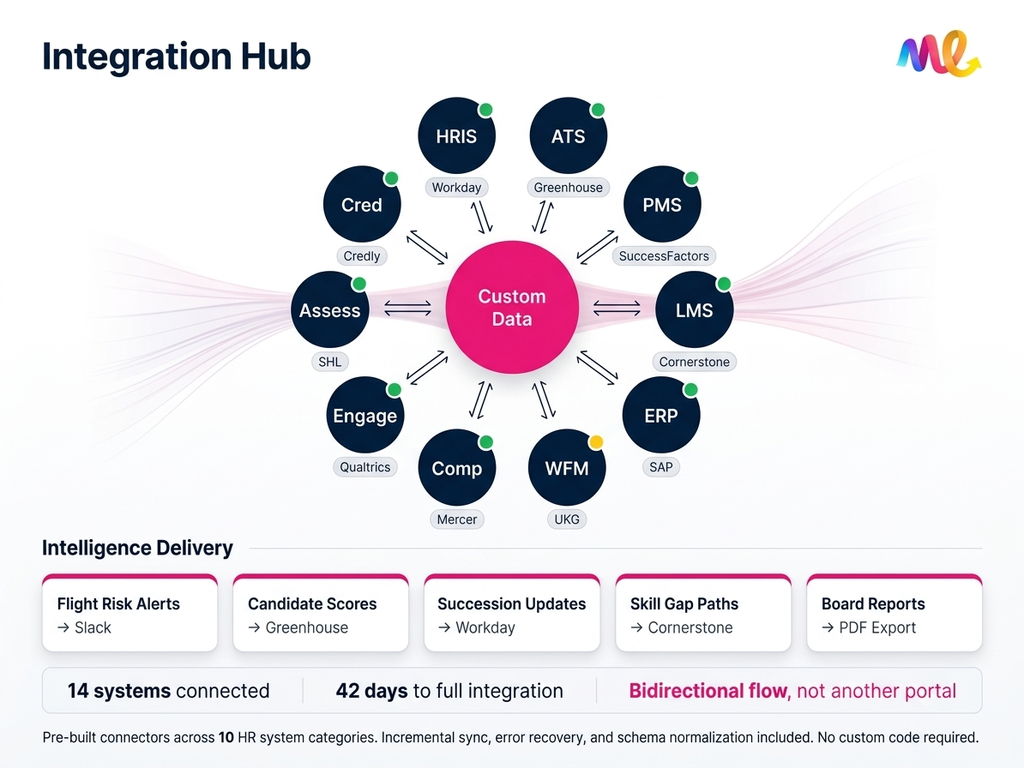
The average enterprise runs 10-15 HR systems that do not talk to each other. The HRIS holds employee records. The ATS holds candidate data. The PMS holds performance reviews. The LMS holds training completions. The ERP holds compensation. Integration projects to connect these into a unified analytics view typically take 12-18 months and cost $2-5M. The platform connects them in 90 days through pre-built connectors with incremental sync, error recovery, and schema normalization.
For multi-entity organizations, the complexity multiplies but the architecture handles it. Different HRIS instances, incompatible job architectures, separate compensation structures, and disconnected credentialing systems across entities all normalize into one workforce view. Cross-entity talent visibility, succession coverage, and benchmarking work from the first month. Entity-level governance rules control who sees what.
What Enterprise Leaders Say
The Intelligence Layer Their Organizations Actually Use
They built their own AI models instead of using generic tools -it shows they've paid attention to accuracy and context, which matters a lot in hiring. Particularly noteworthy is the platform's attention to reducing bias and increasing fairness.
Stevie Awards Judge
Technology Excellence Awards
3,300 applications narrowed to a few dozen. Saved us 10+ days.
Hiring Manager
Manufacturing Firm, Dubai/Germany
The shift from reactive hiring to proactive talent management is a strong product differentiator.
Stevie Awards Judge
Technology Excellence Awards
In a startup, your first hires can make or break you. We created a job spec and the platform handled the rest -I interviewed that evening, made an offer the next day, and haven't looked back. As we scale, all of our future hires will go through Professional.me.
Founder
Health Tech Startup, Abu Dhabi
I find it really easy to find strong profiles, saves lots of time.
Founder
Fintech Startup, Abu Dhabi
They built their own AI models instead of using generic tools -it shows they've paid attention to accuracy and context, which matters a lot in hiring. Particularly noteworthy is the platform's attention to reducing bias and increasing fairness.
Stevie Awards Judge
Technology Excellence Awards
3,300 applications narrowed to a few dozen. Saved us 10+ days.
Hiring Manager
Manufacturing Firm, Dubai/Germany
The shift from reactive hiring to proactive talent management is a strong product differentiator.
Stevie Awards Judge
Technology Excellence Awards
In a startup, your first hires can make or break you. We created a job spec and the platform handled the rest -I interviewed that evening, made an offer the next day, and haven't looked back. As we scale, all of our future hires will go through Professional.me.
Founder
Health Tech Startup, Abu Dhabi
I find it really easy to find strong profiles, saves lots of time.
Founder
Fintech Startup, Abu Dhabi
The candidates and analysis are relevant -the system does all the heavy lifting. The platform is intuitive, and knowing the criteria gives us control and trust in the results.
Talent Acquisition
Government Research Institute, Abu Dhabi
Professional.me gives me a summary of each candidate with downloadable CVs. I reviewed three positions in two hours yesterday. On other platforms, that would take an entire day.
HR Manager
Private Enterprise, Gulf Region
Custom OCR, skill-mapping over 300,000 roles, and bias-reducing human-in-the-loop refinement are solid differentiators. Impressive early traction -123,000 profiles processed and 40 employer accounts.
Stevie Awards Judge
Technology Excellence Awards
I'm thoroughly impressed by the revolutionary approach to workforce intelligence. The proprietary AI infrastructure, built from scratch and trained on hundreds of millions of data points, represents genuine innovation beyond typical HR tech solutions.
Stevie Awards Judge
Technology Excellence Awards
The candidates and analysis are relevant -the system does all the heavy lifting. The platform is intuitive, and knowing the criteria gives us control and trust in the results.
Talent Acquisition
Government Research Institute, Abu Dhabi
Professional.me gives me a summary of each candidate with downloadable CVs. I reviewed three positions in two hours yesterday. On other platforms, that would take an entire day.
HR Manager
Private Enterprise, Gulf Region
Custom OCR, skill-mapping over 300,000 roles, and bias-reducing human-in-the-loop refinement are solid differentiators. Impressive early traction -123,000 profiles processed and 40 employer accounts.
Stevie Awards Judge
Technology Excellence Awards
I'm thoroughly impressed by the revolutionary approach to workforce intelligence. The proprietary AI infrastructure, built from scratch and trained on hundreds of millions of data points, represents genuine innovation beyond typical HR tech solutions.
Stevie Awards Judge
Technology Excellence Awards
Common Questions
What Enterprise Buyers Ask First
Direct answers to the questions we hear from CHROs, CIOs, CFOs, and technical teams evaluating enterprise talent intelligence.

- How long does enterprise integration take from kickoff to live intelligence?
- Foundation tier (HRIS + ERP) goes live in 2-3 weeks. Core intelligence sources (ATS, PMS, compensation) add 1-2 weeks each. Full ecosystem integration across all 10 system categories completes within 90 days. Intelligence starts flowing from week three, not month six.
- Does the platform replace our existing HR systems?
- No. It sits above your stack as an intelligence layer. Data flows in from your HRIS, ATS, LMS, and other systems. Intelligence flows back through those same tools via APIs, alerts, and embedded scores. Your teams keep working where they work. Nobody learns a new tool.
- How does the system handle multi-entity holding companies?
- Normalizes different job architectures, compensation structures, and HR platforms across entities into one unified view. Cross-entity talent visibility, succession coverage, and benchmarking work across organizational boundaries while respecting governance rules and data permissions.
- How accurate are the predictive models, and how quickly do they improve?
- Baseline predictions start at 60-65% accuracy using industry patterns from day one. As models train on your organization's actual outcomes, accuracy reaches 75-85% within 12 months. The system retrains quarterly. Every departure, intervention, and hiring outcome improves the next prediction cycle.
- What is the typical ROI for a 5,000-person organization?
- At $4 per employee per month, the platform costs $240K annually. Preventing 12 mid-level departures covers the cost. Typical enterprise organizations see $17-62M in annual value across retention savings, hiring quality improvement, L&D optimization, and workforce cost modeling. The platform pays for itself from any single outcome category.
- What about data security and compliance?
- SOC 2 Type II certified. GDPR-compliant with right-to-erasure propagation. Field-level encryption at rest and in transit. Role-based access with full audit logging. No email or message content is read. Dedicated tenancy available for organizations with enhanced isolation requirements.
- How does the platform handle GCC and regional compliance?
- Nationalization tracking, Emiratization quotas, WPS wage verification, multi-currency allowances, end-of-service gratuity calculations, and data sovereignty controls are first-class features. Built for the regulatory complexity of GCC, MENA, and global jurisdictions.
Your HR Data Already Knows the Answers
Bring your hardest workforce question. Flight risk, succession gaps, hiring quality, skill shortages. See what happens when your systems talk to each other.