Score Candidates Instantly. Spot Flight Risk in Weeks.
At 50 to 500 people, every hire reshapes the company. The platform scores candidates against top-performer patterns, flags flight risk weekly, and surfaces internal growth paths. Results in days, not quarters.
What You Get Immediately
Five Capabilities That Start Working This Week
Each capability runs on the same unified talent profiles built from your existing systems. Connect your ATS and HRIS. Intelligence starts flowing before onboarding finishes.
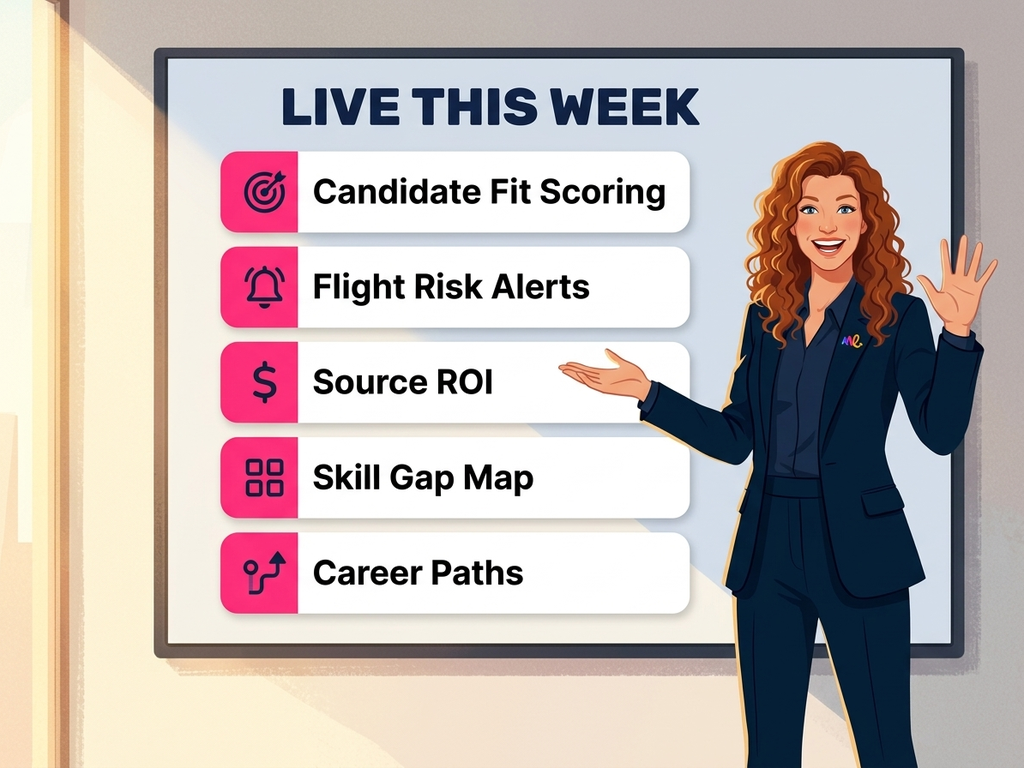
- Candidate Fit Scoring
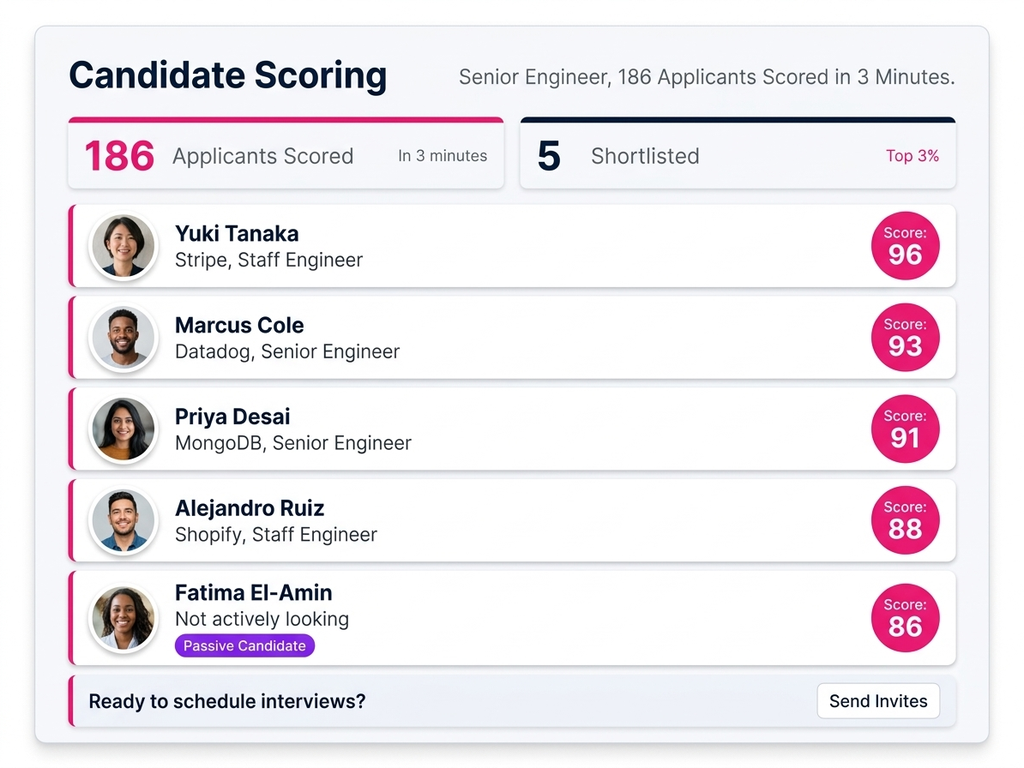
- Scores every applicant against success patterns from your actual top performers. Replaces resume keyword scanning with ranked shortlists that predict who will succeed in your specific environment.
- Learn more
- Flight Risk Alerts
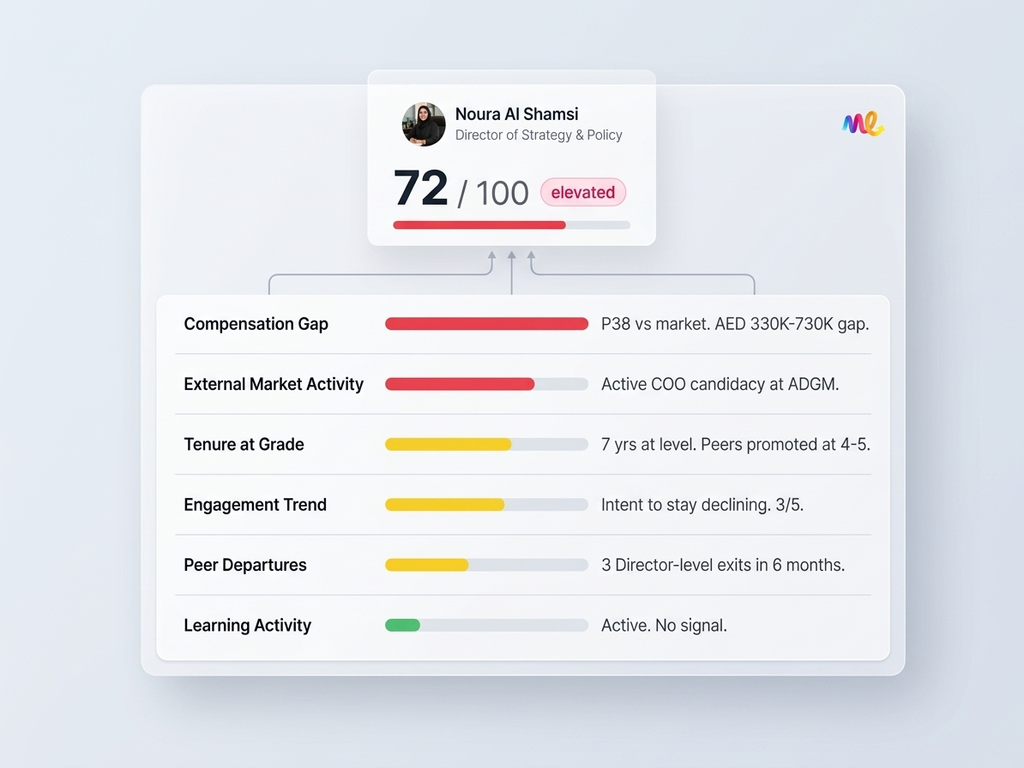
- Flags employees approaching departure before they start interviewing. Names specific drivers: compensation gaps, career stagnation, manager friction. Actionable intelligence from week two.
- Learn more
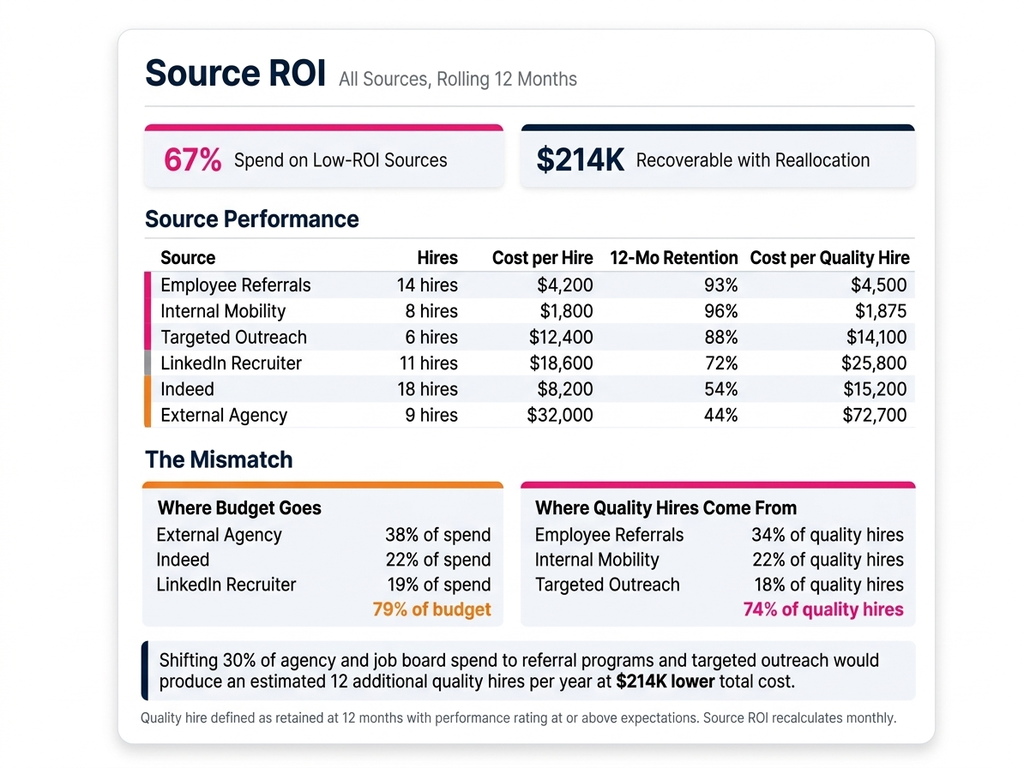
- Source ROI Intelligence
- Measures job boards and agencies by cost per quality hire, not cost per applicant. The typical finding: 60-70% of spend flows to sources producing only 20-30% of lasting hires.
- Learn more
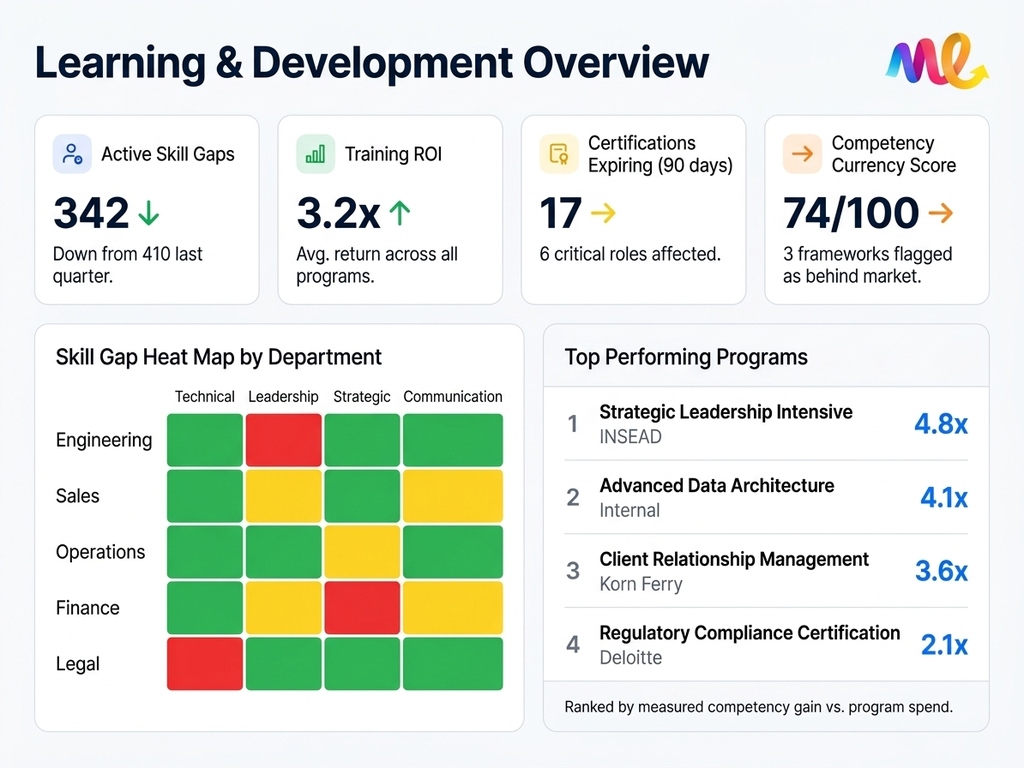
- Skill Gap Mapping
- Maps every employee's demonstrated capabilities against role requirements. Shows where your team is strong and where one resignation would create a capability crisis.
- Learn more
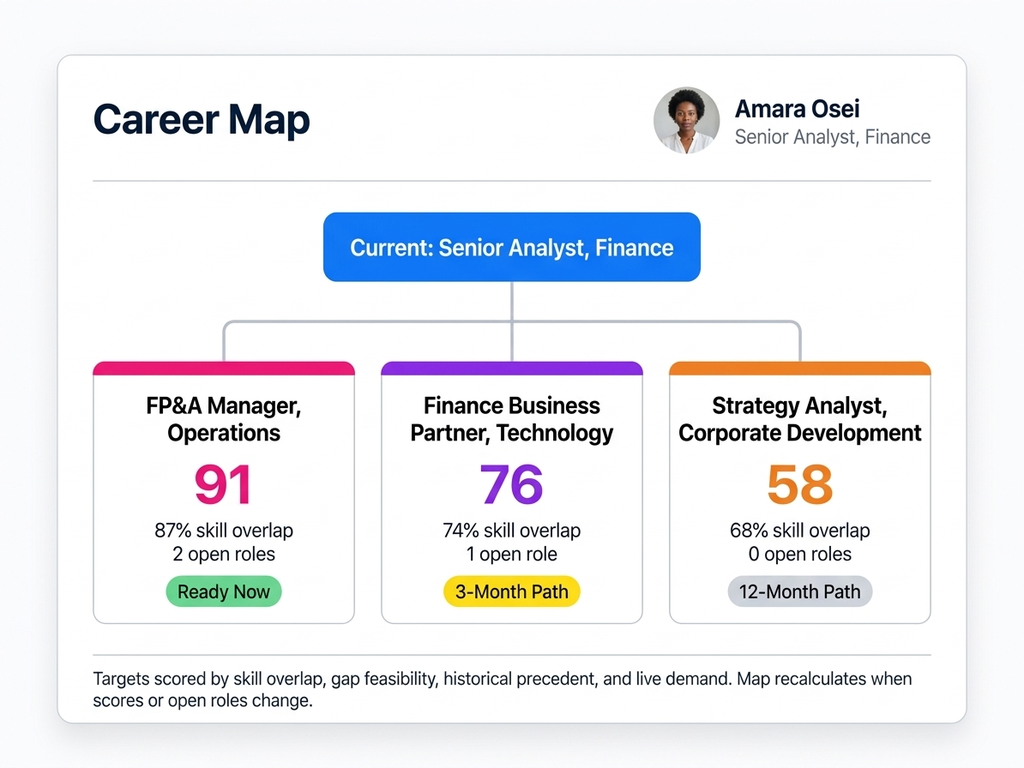
- Career Path Intelligence
- Shows every employee concrete growth options based on actual skills and movement data. People who see a path forward stay. People who see a ceiling start interviewing.
- Learn more

Your first 50 hires will define everything. Ask Meg.
At startup scale, every decision is a company-shaping one. Ask Meg anything about hiring, retention, or team health.
Common prompts (click to see!)
Meg AIVP Engineering Candidate Fit
Connects to the tools startups actually use






Startup Impact
The Numbers That Matter at Startup Scale
At startup scale, every hiring mistake costs 6-9 months of salary and sets a team back a quarter. When your candidate pool runs 50-200 applicants per role and your screening tool is keyword matching on resumes, strong candidates slip through and weak ones waste interview hours. The platform scores every applicant in minutes against patterns derived from people who actually succeeded in similar roles.
Retention intelligence does not require a 5,000-person dataset. The platform starts with industry benchmarks and behavioral patterns on day one, then learns from your specific outcomes as they accumulate. Flight risk alerts go live within two weeks of HRIS integration. At startup scale, preventing two regrettable departures per year covers the platform cost entirely.
Most startup HR consists of one person and a BambooHR login. The platform connects to your HRIS and ATS in days, not months. No data team required. No six-month implementation project. Intelligence surfaces inside the tools your team already opens every morning.
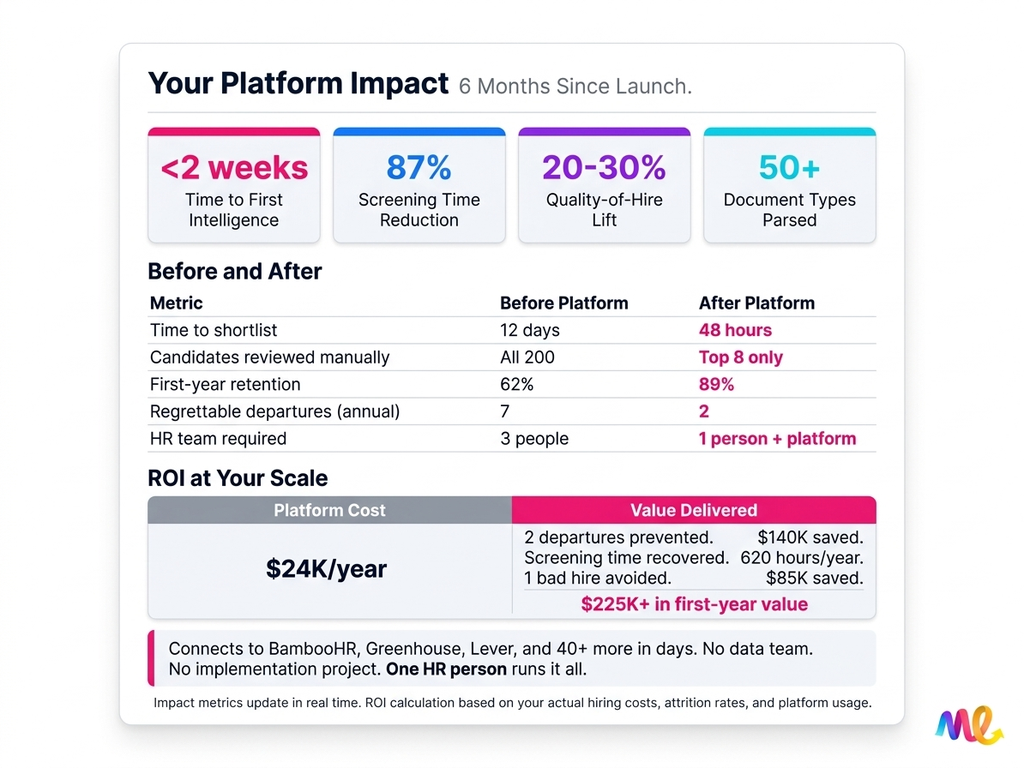
- Time to First Intelligence
- < 2 weeks
- Screening Time Reduction
- 87%
- Quality-of-Hire Lift
- 20-30%
- Document Types Parsed
- 50+
Hiring Intelligence
Stop Screening 200 Resumes to Find 3 Worth Talking To
Ingests applications from your ATS, scores every candidate against success patterns from your actual team, and delivers a ranked shortlist in minutes. Accuracy starts with semantic analysis on day one and improves as hire outcomes accumulate.
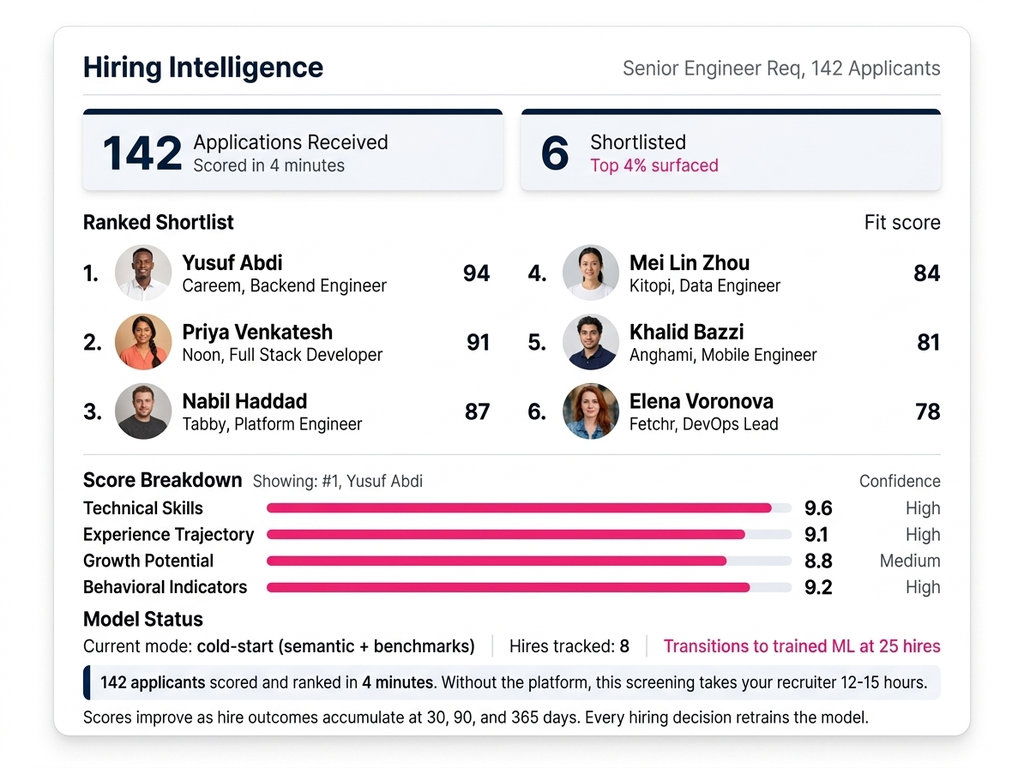
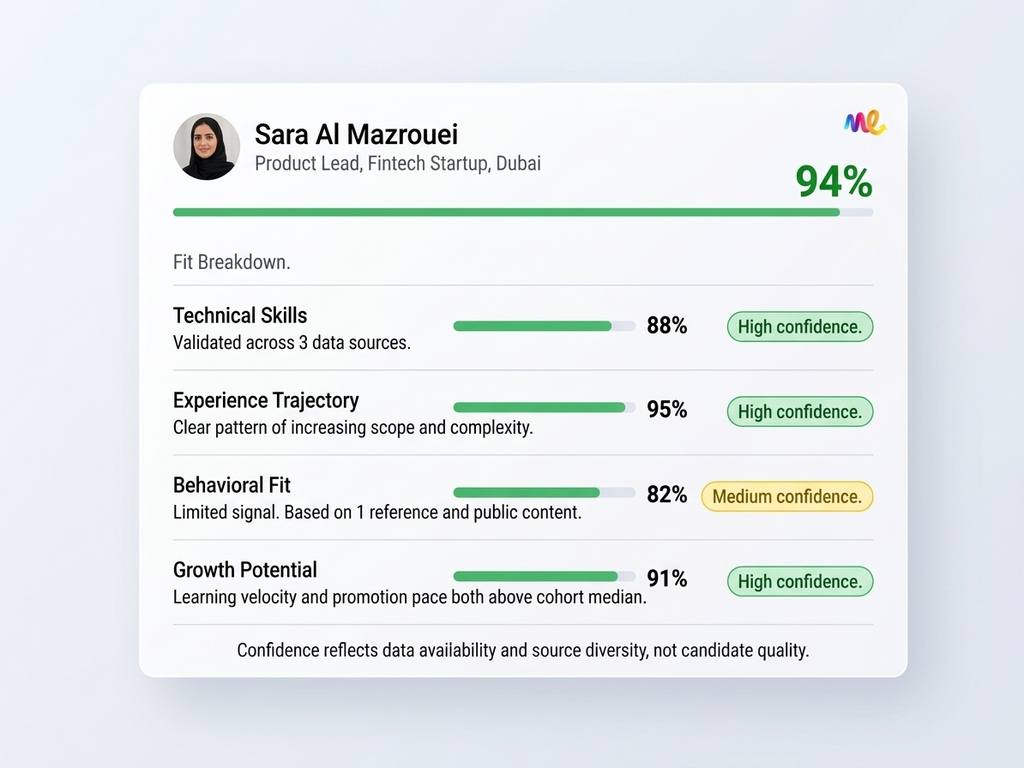
Startups receive 50-200 applications per open role. Most screening today is keyword matching on resumes, a method that misses strong candidates and advances weak ones at roughly equal rates. The platform decomposes each role into structured requirements, scores every applicant across technical skills, experience trajectory, and growth potential, then ranks the field. Recruiters spend time interviewing, not reading.
Cold-start intelligence means you do not wait months for data to accumulate. The scoring engine starts with LLM-based semantic analysis and industry benchmarks, delivering baseline fit scores from the first batch of applications. As hiring outcomes flow back at 30, 90, and 365-day milestones, the model learns what success looks like specifically at your company.
Retention Intelligence
At Your Size, Every Departure Leaves a Crater
Scores every employee's flight risk weekly using compensation, engagement, and behavioral signals. Names the specific drivers behind each risk score. Delivers intervention recommendations the same week the risk surfaces.
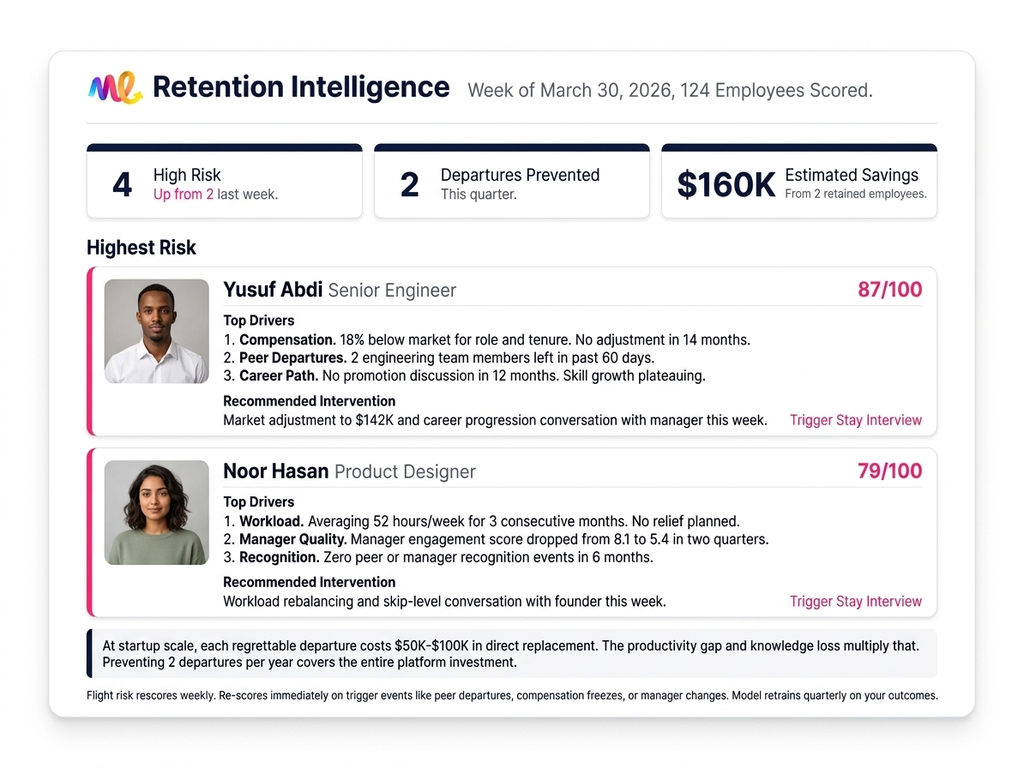
When a company has 100 people and loses a key engineer, the impact is not a line-item cost. It is a delayed product launch, three months of recruiting, and a team that absorbs the workload while morale drops. The platform detects the risk signals months before the resignation letter arrives: compensation gaps widening against market, career progression stalling, peer departures triggering flight patterns.
Retention intelligence does not require enterprise-scale data. The model starts with industry patterns and behavioral signals from day one, then retrains on your organization's specific departures and interventions. Predictions reach actionable accuracy within 60 days of HRIS connection. Each departure or successful retention intervention improves the next cycle.
Growth Intelligence
Scale Without Losing the People Who Got You Here
Maps skill gaps across your team, surfaces internal candidates for new roles as you grow, and shows every employee where they can go next. The intelligence that keeps your best people building instead of job searching.
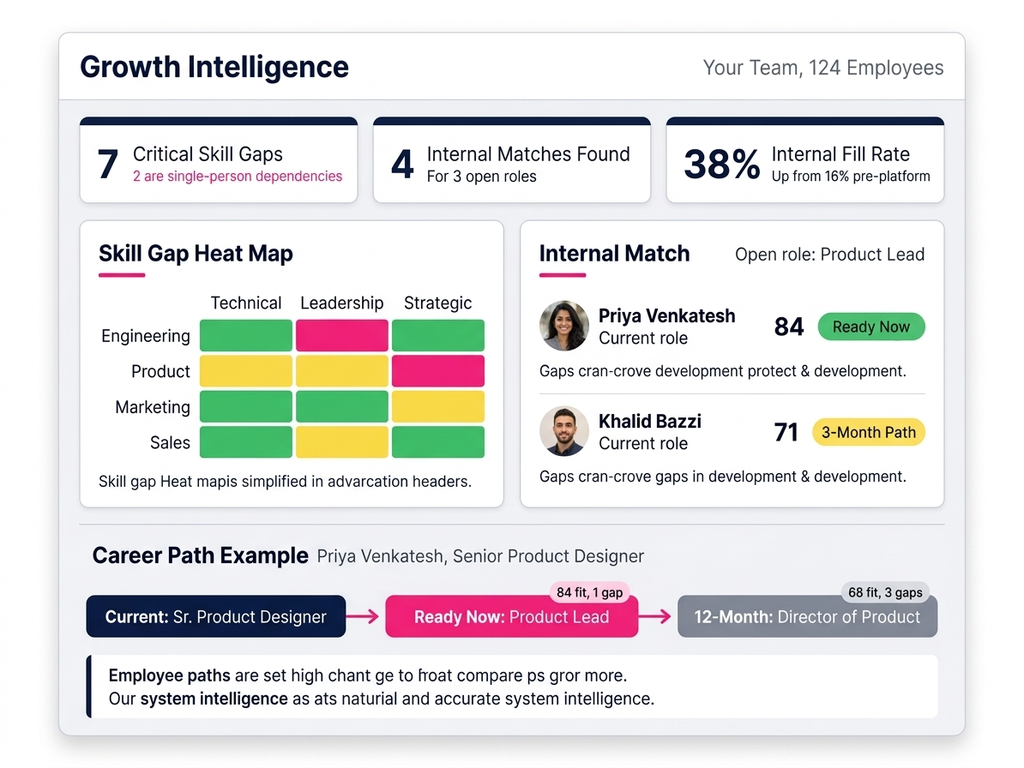
Startups that survive the first phase face a harder problem: scaling without breaking. The engineer who thrived at 30 people may struggle at 150. The marketer hired for execution may be ready for strategy. The platform maps these trajectories using evidence from assessments, project history, and peer feedback so growth decisions come from data, not assumptions.
Internal mobility matters even at 50 people. When every new role gets filled externally, existing employees read the message: growth happens elsewhere. The platform matches open roles to internal candidates first, surfaces readiness data, and maps development paths. Internal fill rates in similar organizations rise from 15-25% to 40-55% within twelve months of adoption.
What Startup Leaders Say
Intelligence That Scales with the Team
3,300 applications narrowed to a few dozen. Saved us 10+ days.
Hiring Manager
Manufacturing Firm, Dubai/Germany
They built their own AI models instead of using generic tools -it shows they've paid attention to accuracy and context, which matters a lot in hiring. Particularly noteworthy is the platform's attention to reducing bias and increasing fairness.
Stevie Awards Judge
Technology Excellence Awards
The candidates and analysis are relevant -the system does all the heavy lifting. The platform is intuitive, and knowing the criteria gives us control and trust in the results.
Talent Acquisition
Government Research Institute, Abu Dhabi
The platform's ability to recognize skill progression and transferability is a strong differentiator. An impressive solution with the potential to transform how organizations hire and plan their workforce.
Stevie Awards Judge
Technology Excellence Awards
3,300 applications narrowed to a few dozen. Saved us 10+ days.
Hiring Manager
Manufacturing Firm, Dubai/Germany
They built their own AI models instead of using generic tools -it shows they've paid attention to accuracy and context, which matters a lot in hiring. Particularly noteworthy is the platform's attention to reducing bias and increasing fairness.
Stevie Awards Judge
Technology Excellence Awards
The candidates and analysis are relevant -the system does all the heavy lifting. The platform is intuitive, and knowing the criteria gives us control and trust in the results.
Talent Acquisition
Government Research Institute, Abu Dhabi
The platform's ability to recognize skill progression and transferability is a strong differentiator. An impressive solution with the potential to transform how organizations hire and plan their workforce.
Stevie Awards Judge
Technology Excellence Awards
In a startup, your first hires can make or break you. We created a job spec and the platform handled the rest -I interviewed that evening, made an offer the next day, and haven't looked back. As we scale, all of our future hires will go through Professional.me.
Founder
Health Tech Startup, Abu Dhabi
We placed 3 candidates in a month. Saved nearly $50K in agency fees.
Hiring Manager
Deep Tech Research, Abu Dhabi
Really impressive growth story. Great to see an AI use case that genuinely helps with recruitment.
Stevie Awards Judge
Technology Excellence Awards
In a startup, your first hires can make or break you. We created a job spec and the platform handled the rest -I interviewed that evening, made an offer the next day, and haven't looked back. As we scale, all of our future hires will go through Professional.me.
Founder
Health Tech Startup, Abu Dhabi
We placed 3 candidates in a month. Saved nearly $50K in agency fees.
Hiring Manager
Deep Tech Research, Abu Dhabi
Really impressive growth story. Great to see an AI use case that genuinely helps with recruitment.
Stevie Awards Judge
Technology Excellence Awards
Common Questions
What Startup Leaders Ask First
Direct answers from founders, heads of people, and technical leaders at companies between 50 and 500 employees.

- We only have BambooHR and Greenhouse. Is that enough data to start?
- More than enough. HRIS employee records plus ATS application data enable candidate fit scoring, baseline flight risk alerts, and pipeline analytics. Each additional source you connect later sharpens accuracy. Most startups see useful intelligence within two weeks of integration.
- How does candidate scoring work when we have limited hiring history?
- Starts with LLM-based semantic analysis and industry benchmarks for baseline accuracy from day one. As your hiring outcomes accumulate at 30, 90, and 365-day milestones, ML models progressively take over. Useful fit scores from week two. Predictive accuracy compounds every quarter.
- We have one HR person. How much setup and maintenance does this require?
- Initial setup takes days of configuration, not weeks of IT projects. Connectors to BambooHR, Greenhouse, Lever, and similar platforms are pre-built. Ongoing maintenance is near zero. The platform syncs automatically, retrains on outcomes, and surfaces intelligence without manual work.
- What does this cost for a 200-person company?
- Pricing scales with headcount. At startup scale, the break-even is preventing one to two regrettable departures per year, each costing $50,000-100,000 in replacement, lost productivity, and team disruption. Most startups recoup the investment within the first quarter of operation.
- Does the platform replace our ATS or HRIS?
- No. It sits above your existing tools as an intelligence layer. Data flows in from BambooHR, Greenhouse, or whatever you run. Intelligence flows back through those same tools. Candidate scores appear in your ATS. Risk alerts arrive in Slack. Nobody learns a new system.
- How accurate is flight risk prediction at our size?
- Baseline accuracy starts at 60-65% using industry behavioral patterns from day one. The model improves as it learns your specific patterns. At 200+ employees, there is enough signal for meaningful prediction within 60-90 days. Each departure and each retention win refines the next cycle.
- Can employees see their own career paths and skill gaps?
- Yes. Each employee gets a self-service view showing career paths, skill adjacencies, and matched learning recommendations. At startup scale, this visibility is a retention tool by itself. People who see growth options stay longer. Permissions are configurable by role.
Your Team Is Small Enough to Get This Right
Bring your toughest hiring challenge to the demo. See how the platform scores candidates, flags retention risk, and maps growth paths for teams that cannot afford to guess.