You're Competing for the Same 10,000 Engineers. Most Aren't Looking.
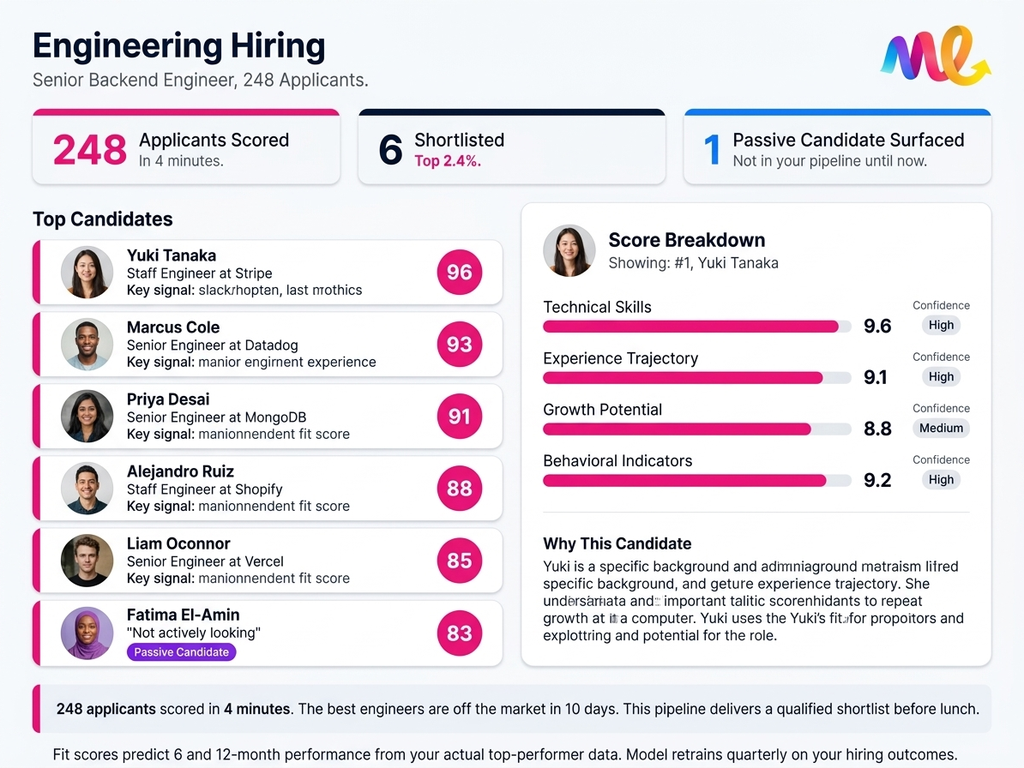
Tech hiring is a speed and signal problem. The platform scores candidates against your top-performer patterns, sources passive talent before recruiters do, and turns every outcome into data that compounds.
Industry Overview
Talent Intelligence for Companies Where Engineering Is the Product
Technology companies live and die by their ability to hire, retain, and develop engineers. The average time to fill a senior engineering role is 62 days. The average cost when you factor in lost productivity, interviewer time, and agency fees exceeds $80,000 per hire. And 30-40% of those hires will not make it past twelve months because resume screening and unstructured interviews are terrible predictors of engineering success.
The competitive landscape makes everything harder. FAANG companies set compensation floors that mid-market firms struggle to match. Remote work expanded the talent pool but also expanded the competition to every funded startup with a Greenhouse account. The engineers you want are already employed, not applying to job boards, and getting sourced by 15 recruiters a week.
The platform addresses both sides of the problem. On the hiring side, predictive fit scoring replaces keyword matching with models trained on what actually predicts engineering success at your company. On the retention side, flight risk intelligence identifies which engineers are being targeted, what is driving their risk, and which interventions will keep them before the recruiter message converts.
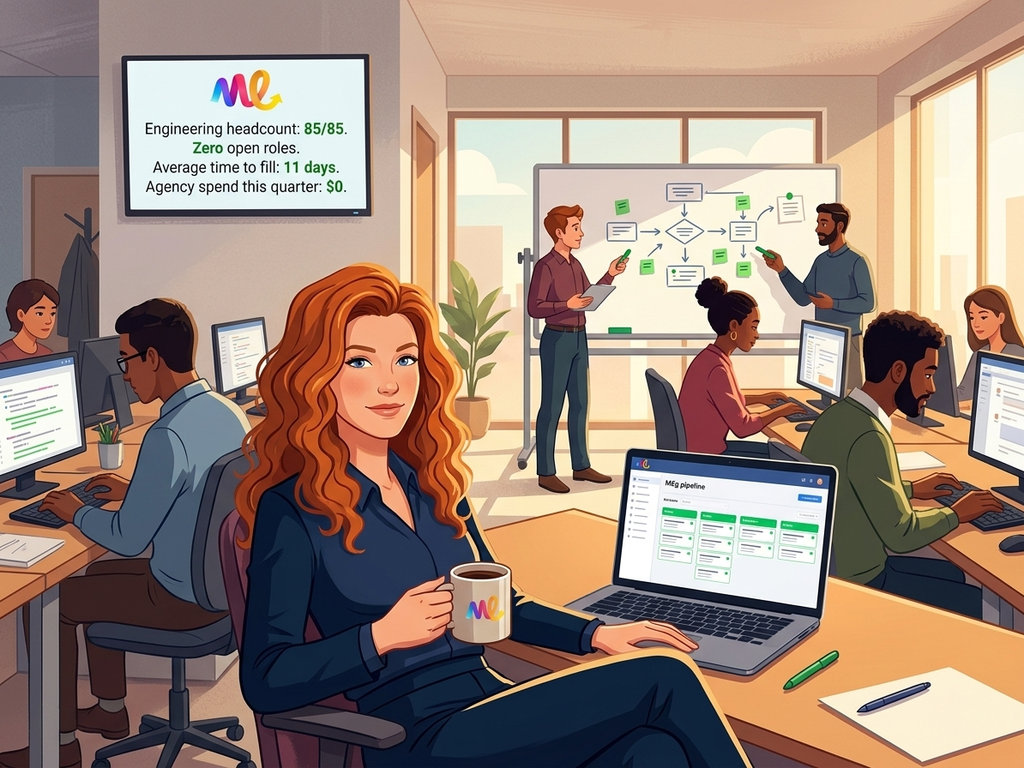

Your engineers are your moat. Know who stays.
From IC retention to engineering leadership pipelines, ask Meg about the talent behind your product.
Common prompts (click to see!)
Meg AIPoaching Risk — Senior Engineers
Senior Engineers at Risk
4 of 18
22% of senior ICs
Avg Comp Gap
16%
Below competing offers
Replacement Cost (4)
$1.2M
Recruiting + ramp
Institutional Knowledge
28 years
Combined tenure at risk
Engineering Hiring
Stop Losing Candidates to Your Own Process
The best engineers are off the market in 10 days. Your process takes 45. The platform compresses time-to-qualified-shortlist to 48 hours, scores candidates on what predicts engineering success, and keeps your pipeline moving faster than candidates can disengage.
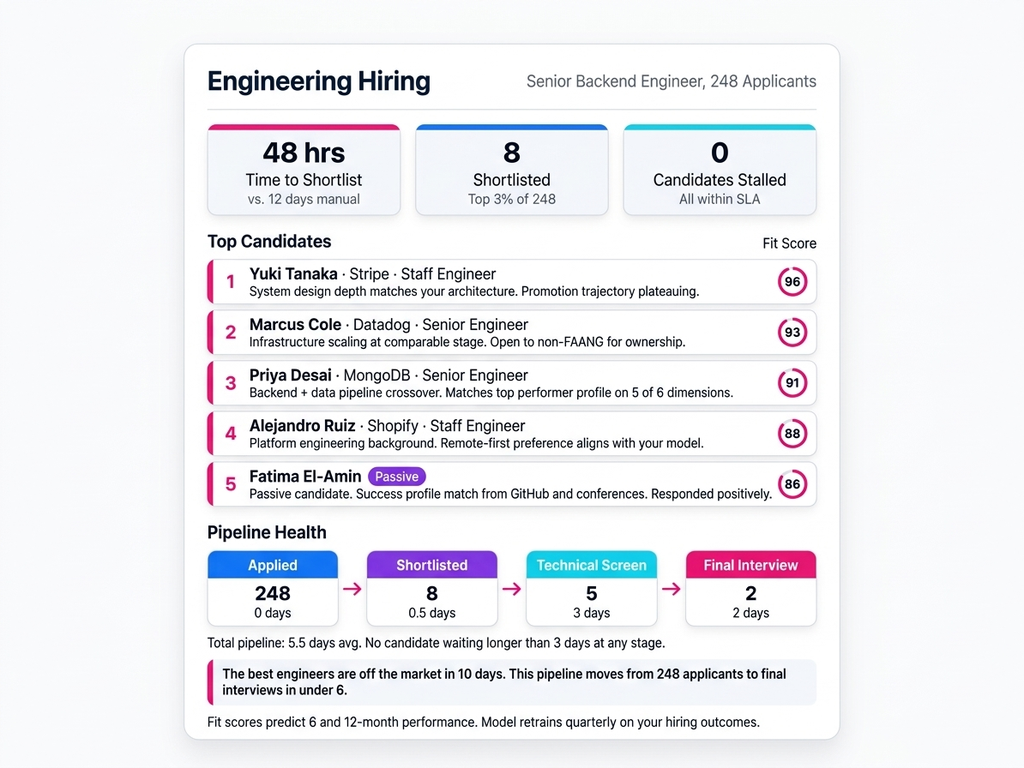
Engineering hiring processes are broken in predictable ways. Job descriptions list 15 requirements when 4 actually predict success. Technical screens filter for algorithm trivia instead of system design capability. Interview loops involve 6-8 people over 3-4 weeks, by which point the top candidate has accepted an offer from the company that moved in 10 days. The platform attacks each failure mode with data.
Predictive fit scoring analyzes your historical hiring and performance data to identify which skills, experiences, and patterns actually predict engineering success at your company. The model does not care about pedigree or keyword density. It cares about the signal that correlates with six-month performance, twelve-month retention, and team impact. For passive candidates, the platform identifies engineers who match your success profile, crafts outreach calibrated to their likely motivations, and gauges interest before your recruiters invest time.
Engineering Retention
Keep the Engineers That Every Recruiter on LinkedIn Is Targeting
Your senior engineers receive 10-15 recruiter messages per week. Most of them ignore them. Until they don't. The platform identifies which engineers are approaching the tipping point and what specific lever will keep them before the conversation with a competitor starts.
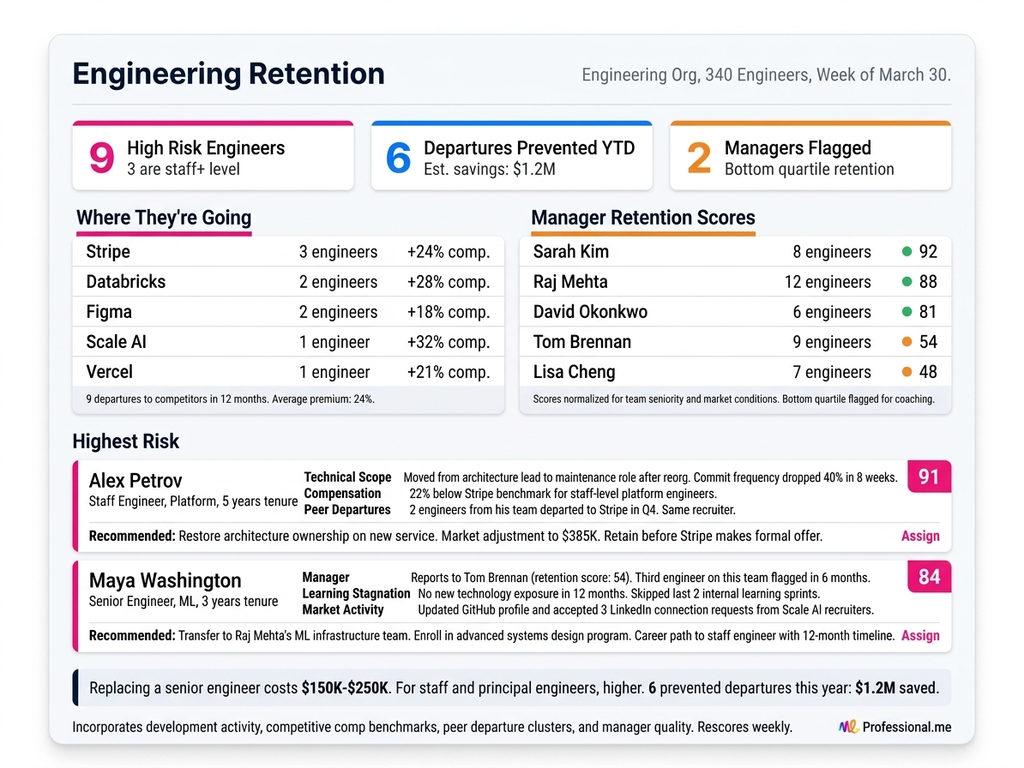
Engineering attrition in technology companies follows patterns that are visible months before the resignation. Declining commit frequency, reduced code review participation, skipped learning opportunities, and peers departing to the same competitor are all signals the data sees before the manager notices. The platform ingests these alongside compensation gaps, promotion velocity, and engagement data to score flight risk weekly.
The interventions that retain engineers are not the same ones that retain salespeople. Engineers leave for technical challenge, autonomy, compensation, and the quality of the team around them. A retention bonus does not fix a boring codebase. A title bump does not fix a manager who micromanages pull requests. The platform matches each engineer's top risk drivers to interventions that address the actual cause.
Why Technology Is Different
Workforce Challenges in an Industry Where Talent Is the Entire Moat
Technology companies compete on the quality of their engineering teams. Compensation transparency, remote work, and a permanent seller's market for senior engineers create workforce dynamics that traditional HR tools were not built for.
Built for Engineering-Led Organizations
Technology workforce decisions move at a pace that quarterly planning cycles cannot match. A competitor launches a new product, and suddenly your ML team is being recruited. A funding round closes, and three competitors start hiring for the same 50 roles. A key architect resigns, and six months of roadmap is at risk. The platform provides continuous intelligence so engineering leaders and talent teams see these dynamics in real time, not in a quarterly business review. When the VP of Engineering asks how exposed the platform team is to attrition, the answer is a live dashboard with individual risk scores, driver attribution, and recommended interventions, not a promise to look into it.



- Avg Senior Eng Replacement Cost
- $150-250K
- Avg Days to Fill (Industry)
- 62
- First-Year Engineering Attrition
- 30-40%
- Recruiter Messages per Eng/Week
- 10-15
What Our Clients Say
Trusted by teams in this industry
Professional.me gives me a summary of each candidate with downloadable CVs. I reviewed three positions in two hours yesterday. On other platforms, that would take an entire day.
HR Manager
Private Enterprise, Gulf Region
3,300 applications narrowed to a few dozen. Saved us 10+ days.
Hiring Manager
Manufacturing Firm, Dubai/Germany
The candidates and analysis are relevant -the system does all the heavy lifting. The platform is intuitive, and knowing the criteria gives us control and trust in the results.
Talent Acquisition
Government Research Institute, Abu Dhabi
The platform's ability to recognize skill progression and transferability is a strong differentiator. An impressive solution with the potential to transform how organizations hire and plan their workforce.
Stevie Awards Judge
Technology Excellence Awards
The results are excellent. I believe there's a real future for this platform, and I'm going to recommend it to everyone I know who runs a firm.
Ibrahim Haidar
Managing Director, General Engineering Company, Lebanon
A fresh take on AI in talent management. The proprietary infrastructure, built from the ground up, clearly sets it apart. The emphasis on real-time data enrichment and skill-task mapping demonstrates a serious commitment to fairness and technical rigor.
Stevie Awards Judge
Technology Excellence Awards
Professional.me gives me a summary of each candidate with downloadable CVs. I reviewed three positions in two hours yesterday. On other platforms, that would take an entire day.
HR Manager
Private Enterprise, Gulf Region
3,300 applications narrowed to a few dozen. Saved us 10+ days.
Hiring Manager
Manufacturing Firm, Dubai/Germany
The candidates and analysis are relevant -the system does all the heavy lifting. The platform is intuitive, and knowing the criteria gives us control and trust in the results.
Talent Acquisition
Government Research Institute, Abu Dhabi
The platform's ability to recognize skill progression and transferability is a strong differentiator. An impressive solution with the potential to transform how organizations hire and plan their workforce.
Stevie Awards Judge
Technology Excellence Awards
The results are excellent. I believe there's a real future for this platform, and I'm going to recommend it to everyone I know who runs a firm.
Ibrahim Haidar
Managing Director, General Engineering Company, Lebanon
A fresh take on AI in talent management. The proprietary infrastructure, built from the ground up, clearly sets it apart. The emphasis on real-time data enrichment and skill-task mapping demonstrates a serious commitment to fairness and technical rigor.
Stevie Awards Judge
Technology Excellence Awards
Common Questions
What Technical Leaders Ask First
Direct answers to the questions we hear from CTOs, VPs of Engineering, and technical recruiting leaders evaluating talent intelligence for technology companies.

- How does predictive fit scoring work for engineering roles specifically?
- The model trains on your historical engineering hires and their outcomes: code quality metrics, peer review feedback, sprint velocity, promotion trajectory, and retention. It learns which candidate signals predict success at your company, not generic software engineering benchmarks. Accuracy reaches 0.55+ correlation within twelve months.
- Does the platform integrate with our ATS and engineering tools?
- ATS: Greenhouse, Lever, Ashby, and Workable. HRIS: Workday, BambooHR, Rippling. The platform also ingests signals from GitHub, Jira, and linear where organizations opt in. All integrations are read-only for development tools, and individual contributor metrics are never surfaced to management.
- How does passive candidate sourcing differ from what our recruiters already do on LinkedIn?
- Recruiters source by keyword and title. The platform scores candidates against your actual top-performer success patterns using demonstrated capability data, not resume keywords. It identifies engineers who match but would never surface in a boolean search, crafts outreach based on their likely motivations, and only escalates candidates who show genuine interest.
- We are a 200-person startup. Is this built for enterprise only?
- The platform scales from Series A through public company. Smaller companies benefit more from predictive scoring because they cannot afford hiring mistakes. No ATS required. The platform provides structure for companies that do not have recruiting operations yet and layers intelligence on top for those that do.
- How does the system handle remote and distributed engineering teams?
- Compensation benchmarking adjusts for location, cost-of-living, and local market dynamics. Flight risk scoring incorporates remote-specific signals like meeting load changes, collaboration pattern shifts, and timezone overlap reduction. Internal mobility matching includes remote eligibility and timezone constraints.
- What about bias in engineering hiring models?
- Demographic features are excluded from scoring models. Continuous bias auditing checks whether recommendations disproportionately favor or exclude any group. Funnel analytics by demographic group surface patterns at every stage. The system is specifically designed to reduce the school-pedigree and keyword biases that plague traditional engineering hiring.
Your Best Engineers Are Getting Recruited Right Now
See how the platform scores engineering candidates, identifies passive talent, and predicts which of your current team members are at risk before the recruiter message lands.