Your Workforce Crisis Has a Data Problem, Not Just a Supply Problem
Healthcare loses 100,000+ nurses annually to burnout. The platform connects clinical credentialing, retention signals, and workforce forecasting into one intelligence layer that acts before the resignation letter.
Industry Overview
Workforce Intelligence Built for Clinical Complexity
Healthcare workforce management operates under constraints that generic HR platforms ignore. Credentialing timelines, shift-based scheduling, union agreements, mandatory staffing ratios, and the compounding cost of a single unfilled clinical position create an operating environment where traditional talent tools break down.
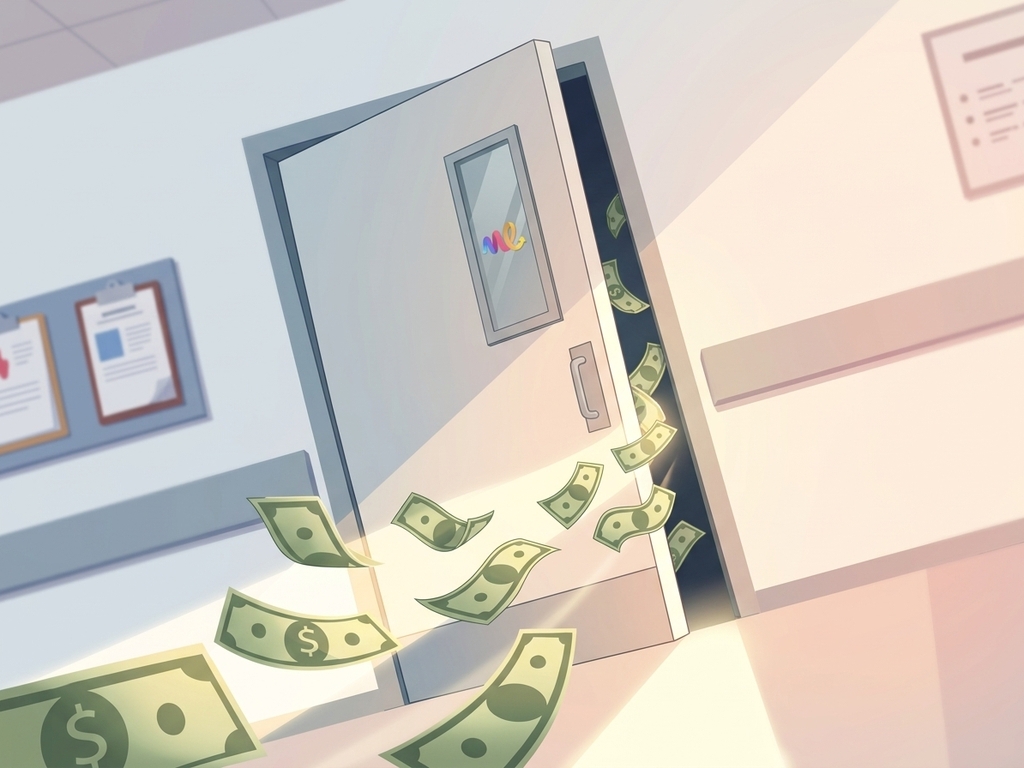
The average hospital spends $56,000 replacing a single bedside nurse and $500,000 replacing a specialist physician. Most of that cost is preventable. Flight risk was visible in the data months before the resignation letter. The successor was already on staff but invisible to the search committee. The credential lapse that pulled a provider off the floor could have been caught ninety days earlier.
The platform connects your HRIS, credentialing system, scheduling platform, and performance data into unified workforce profiles. Predictive models trained on healthcare-specific patterns surface intelligence that generic tools miss: which units are approaching burnout thresholds, which credentials will lapse next quarter, which internal candidates are ready for charge nurse roles they have never been considered for.


Your workforce is your care quality. Ask Meg.
From nurse retention to credentialing compliance, ask Meg about the people behind every patient outcome.
Common prompts (click to see!)
Meg AINursing Burnout & Flight Risk by Unit
ICU has had 14 consecutive weeks of mandatory overtime. 6 of 22 ICU nurses have active job applications elsewhere. ER burnout is driven by 3 unfilled positions creating 16-hour shifts.
Immediate Actions
ICU: approve travel nurse coverage for 4 weeks
Cost: $48K. This breaks the mandatory overtime cycle and gives your permanent staff breathing room to recover.
ER: expedite the 3 open hires
2 candidates are in final interviews. Move offer timelines from 2 weeks to 48 hours — you are competing with the hospital across town.
System-wide: implement burnout pulse survey
Monthly 5-question check-in. Early warning beats exit interview data by 90 days.
Retention & Staffing
Predict Turnover by Unit Before It Becomes a Staffing Emergency
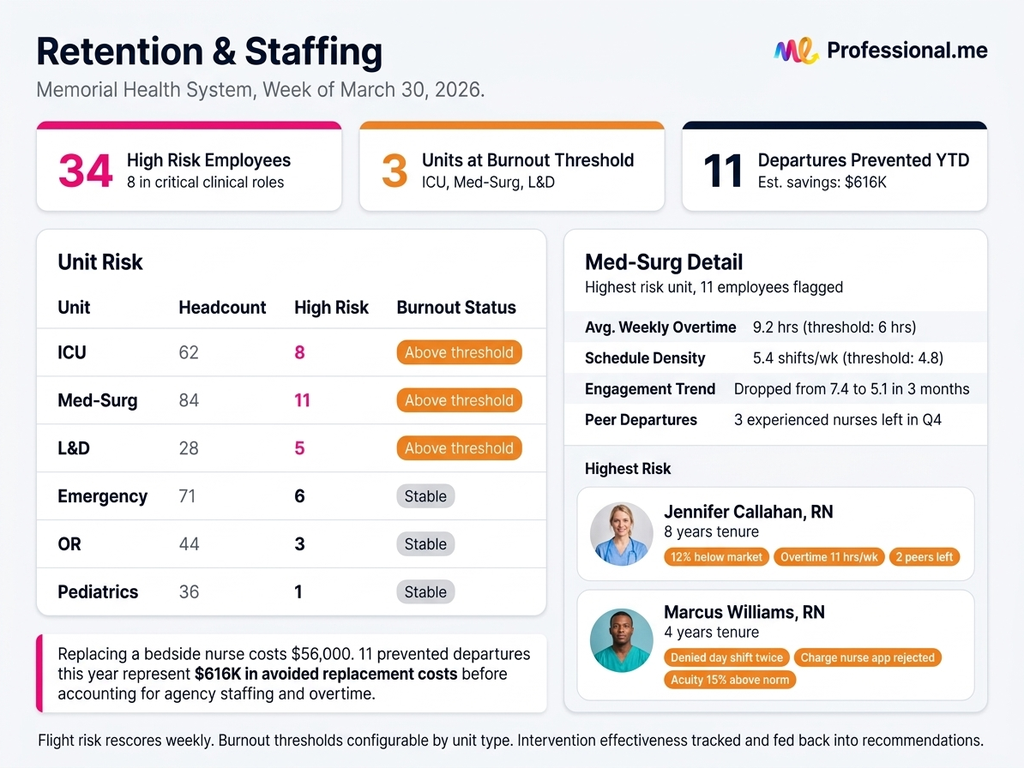
Clinical turnover is not random. It clusters by unit, shift, manager, and tenure band. The platform scores flight risk weekly for every employee, names the drivers, and recommends interventions calibrated to each individual's situation.
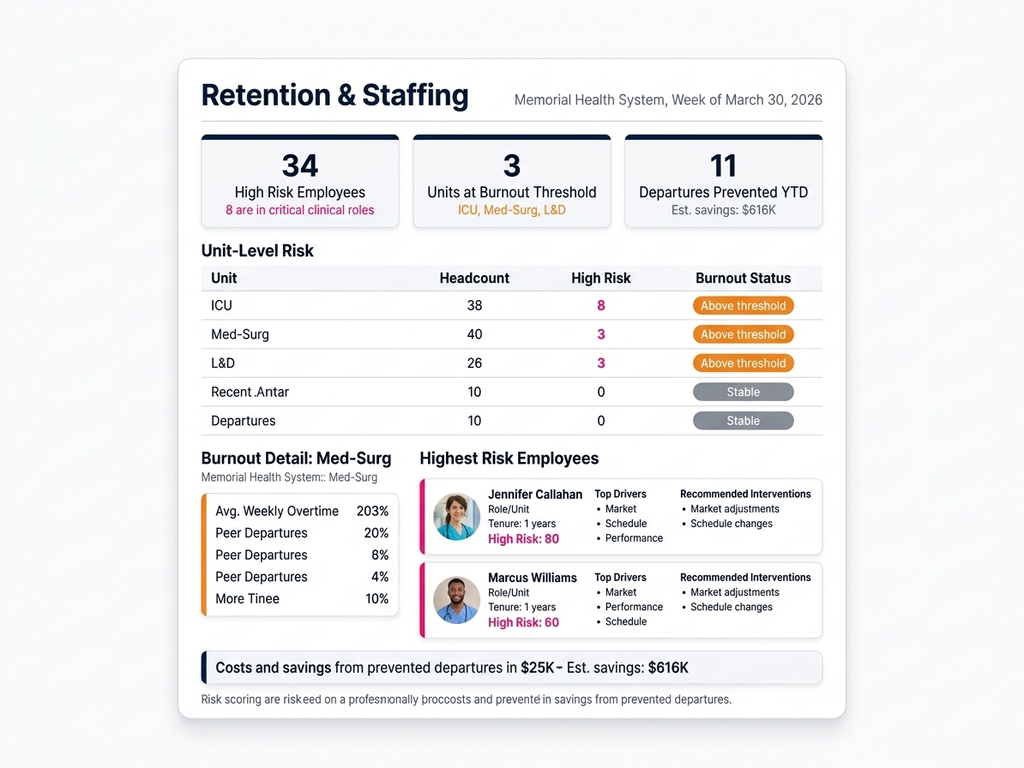
A med-surg unit losing three experienced nurses in the same quarter is not bad luck. It is a pattern the data saw forming months earlier: rising overtime, declining engagement scores, a compensation gap that opened when the market moved and your bands did not. The platform connects these signals into a flight risk score that updates weekly and re-scores immediately on high-signal events like a manager change or a missed promotion cycle.
Interventions matter most when they are specific. A retention bonus does not fix a scheduling problem. A career conversation does not fix a pay gap. The platform matches each employee's top risk drivers to proven interventions and tracks whether the intervention actually moved the score. Over twelve months, the system learns which actions work for which populations in your organization, not in a generic benchmark.
Credentialing & Compliance
Eliminate Credential Lapses Before They Pull Providers Off the Floor
A single lapsed credential can remove a provider from patient care for weeks. The platform monitors every license, certification, and privileging requirement across your workforce with predictive alerts that trigger renewal workflows ninety days before expiry.
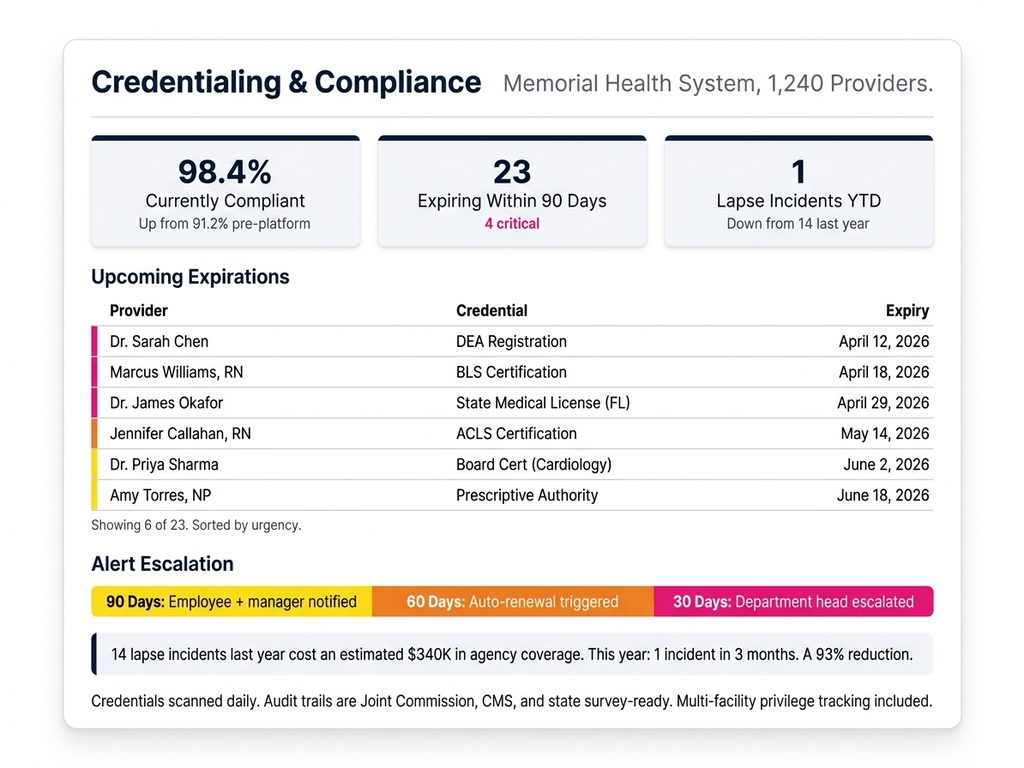
Most health systems track credentials in spreadsheets or credentialing platforms disconnected from workforce planning. When a credential lapses, the discovery is reactive: a provider cannot be scheduled, a unit is short-staffed, and agency costs spike. The platform integrates credentialing data into the unified workforce profile so every license, board certification, DEA registration, and facility privilege is monitored continuously against role requirements.
For multi-facility systems, the complexity multiplies. A nurse credentialed at Hospital A may not have current privileges at Hospital B. A traveling provider's state licenses may expire on different cycles. The platform normalizes these across facilities and jurisdictions, flags approaching expirations by priority, and auto-enrolls providers in renewal workflows where available.
Why Healthcare Is Different
Workforce Challenges That Generic HR Tools Were Not Built For
Healthcare operates under regulatory, clinical, and operational constraints that make standard talent platforms insufficient. The platform was built to handle the complexity that healthcare workforce leaders actually face.
Built for Clinical Workforce Reality
Mandatory staffing ratios, 24/7 shift coverage, credential-dependent practice authority, union agreements, and the compounding cost of clinical vacancies create workforce dynamics that no generic HRIS addresses. The platform connects scheduling, credentialing, retention, and workforce planning into one intelligence layer that understands these constraints. When a charge nurse resigns, the system does not just flag a vacancy. It calculates the coverage impact, identifies internal successors, estimates the agency cost of the gap period, and recommends the intervention that would have prevented the departure.

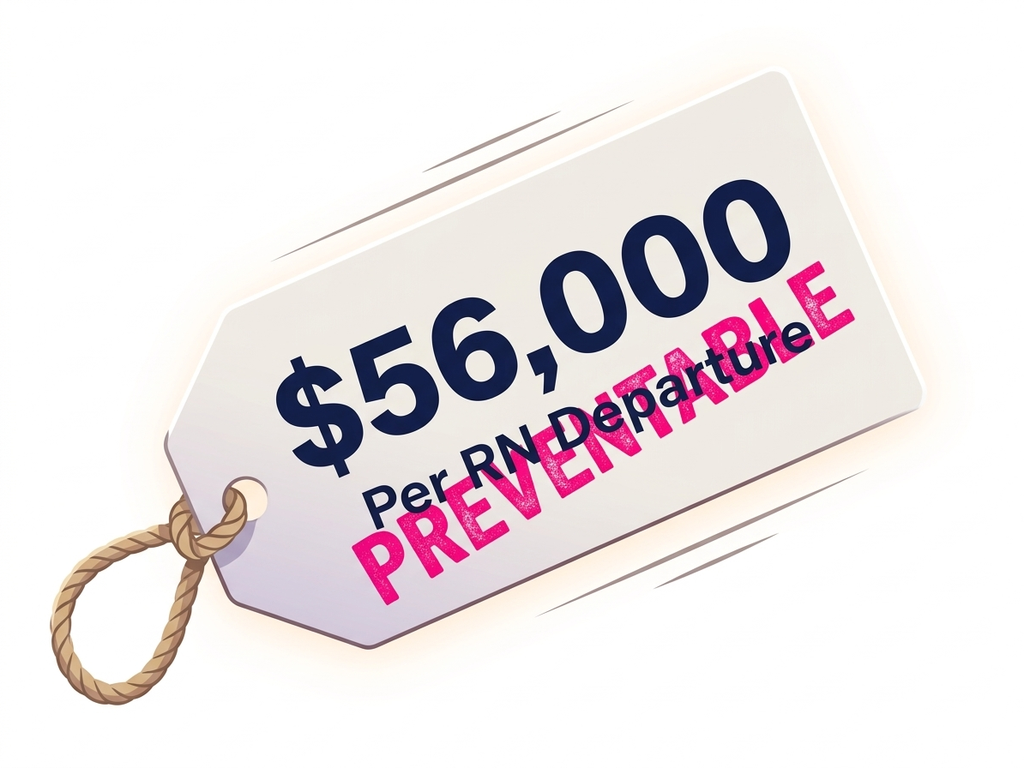

- Average RN Replacement Cost
- $56K
- Annual Nurse Turnover Rate
- 18-27%
- Credential Types Monitored
- 50+
- Typical Year-One Retention Savings
- $4-8M
What Our Clients Say
Trusted by teams in this industry
We placed 3 candidates in a month. Saved nearly $50K in agency fees.
Hiring Manager
Deep Tech Research, Abu Dhabi
3,300 applications narrowed to a few dozen. Saved us 10+ days.
Hiring Manager
Manufacturing Firm, Dubai/Germany
I find it really easy to find profiles. Saves me so much time gathering and identifying candidates. I see the advantage of using the platform compared to an agency.
Director
Technology Consulting, UAE
Unlike other AI tools that required training periods with unclear ratings, Professional.me's scoring was immediately understandable and actionable.
Hiring Manager
Defense Company, Abu Dhabi
Compelling vision for using AI in recruiting. Insightful entry and great supporting documentation.
Stevie Awards Judge
Technology Excellence Awards
The results are there, even with the limited time I've spent on the platform. I'm sure spending more time and getting the team involved will surface even more great candidates.
Director
Technology Consulting, UAE
We placed 3 candidates in a month. Saved nearly $50K in agency fees.
Hiring Manager
Deep Tech Research, Abu Dhabi
3,300 applications narrowed to a few dozen. Saved us 10+ days.
Hiring Manager
Manufacturing Firm, Dubai/Germany
I find it really easy to find profiles. Saves me so much time gathering and identifying candidates. I see the advantage of using the platform compared to an agency.
Director
Technology Consulting, UAE
Unlike other AI tools that required training periods with unclear ratings, Professional.me's scoring was immediately understandable and actionable.
Hiring Manager
Defense Company, Abu Dhabi
Compelling vision for using AI in recruiting. Insightful entry and great supporting documentation.
Stevie Awards Judge
Technology Excellence Awards
The results are there, even with the limited time I've spent on the platform. I'm sure spending more time and getting the team involved will surface even more great candidates.
Director
Technology Consulting, UAE
Common Questions
What Healthcare Leaders Ask First
Direct answers to the questions we hear from CNOs, CMOs, CHROs, and workforce planning teams evaluating talent intelligence for healthcare.

- Does the platform integrate with clinical credentialing systems?
- Yes. Pre-built connectors for Symplr, MD-Staff, Cactus, and modular health. Credentials flow into unified workforce profiles alongside HRIS, scheduling, and performance data. Custom connectors handle proprietary credentialing platforms without code.
- How does flight risk scoring work for shift-based clinical staff?
- The model incorporates healthcare-specific signals: overtime concentration, shift pattern changes, mandatory scheduling conflicts, credential renewal gaps, and patient acuity exposure. These signals are weighted alongside standard retention factors like compensation gaps and manager quality.
- Can the system handle multi-facility health systems with different credentialing requirements?
- Built for it. Each facility's credentialing requirements, privileging rules, and state regulations are modeled separately. The platform normalizes these into one provider profile that shows credential status per facility, identifies cross-facility gaps, and tracks renewal timelines across jurisdictions.
- How quickly does the platform deliver value in a healthcare setting?
- Credential compliance monitoring produces actionable alerts within three weeks. Flight risk scoring starts generating unit-level retention intelligence by month two. Succession readiness scoring for clinical leadership roles matures between months six and twelve.
- Does the platform handle union workforce considerations?
- Yes. Seniority-based rules, collective bargaining constraints, and bumping rights are configurable per bargaining unit. Internal mobility matching and succession planning respect these constraints. Transfer feasibility checks include union agreement compliance automatically.
- What about HIPAA and patient data?
- The platform processes workforce data, not patient data. No PHI is ingested, stored, or processed. SOC 2 Type II certified with field-level encryption at rest and in transit. Role-based access controls ensure clinical leaders see their population only.
Your Next Nursing Vacancy Is Predictable. So Is Preventing It.
See how the platform scores clinical flight risk, monitors credentials in real time, and turns workforce data into the intelligence your CNO and CHRO need to act before the resignation letter arrives.